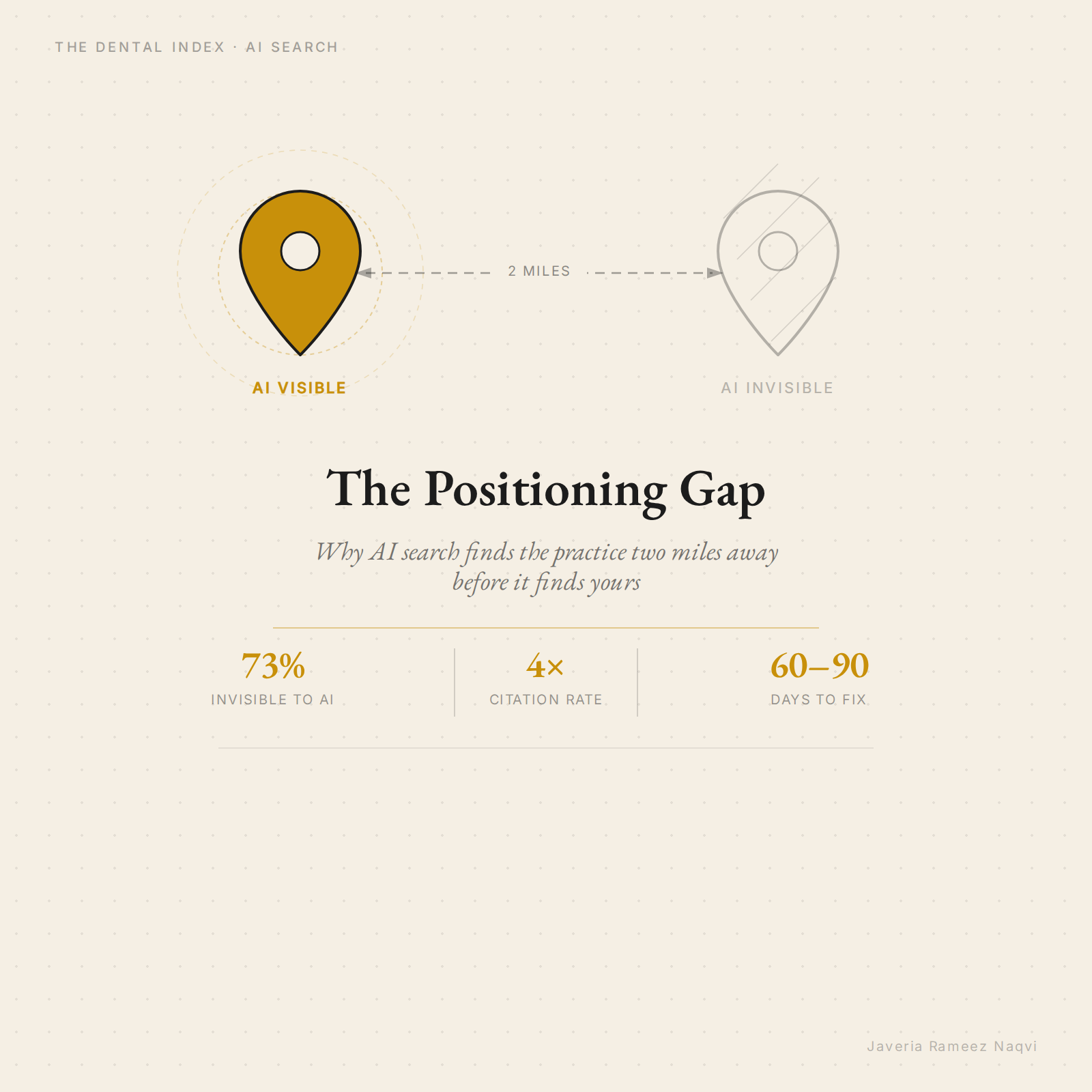
Consider a practice like this one: a solo dentist, eleven years into her career, single location in a mid-size suburban market, with a genuine clinical focus on implants and full-mouth cosmetic work. She places implants every week. Her full-arch restorations are among the best in the region. She spent $2,800 last month on digital ads. The front desk logged four new patient calls. None of them were implant inquiries. Her chair time runs at 78% capacity, her hygiene recall is full, and she cannot figure out why the cases she most wants never seem to find her. A pattern that appears repeatedly across the practices we audited: the problem is not her clinical skill, her patient care, or her budget. Her website says 'comprehensive family dentistry.' Her reviews mention cleanings and checkups. When a patient two miles away opens ChatGPT and types 'best dentist for implants near me,' the AI does not surface her practice. It surfaces the practice down the street whose website has a dedicated implants page and whose reviews mention full-arch restorations.
A pattern the audit surfaces repeatedly: a solo practice with a skilled clinician, solid chair time, and a real appetite for implants and cosmetic cases, spending thousands per month on digital ads, and still getting calls mostly from patients asking about cleanings and checkups. Not because the dentist is doing anything wrong. Because the signal their practice sends into the world does not match the work they want to attract.
This is not a volume problem. It is a positioning problem. And in 2026, that positioning problem shows up most clearly in one place: whether or not AI search recommends your practice when a patient types a high-value query into ChatGPT or Google.
Why Are High-Value Patients Not Finding Your Practice?
Think about two patients who might call your practice in the same week. The first is due for a cleaning. She is not urgent, she will go wherever her insurance covers, and she will find you through habit or a friend's referral. The second patient is researching full-mouth implants. He has been reading about different practices for three weeks. He is ready to spend. He will find you, or he will not, based entirely on what AI search tells him when he asks his question.
When a patient wants implants, a full-mouth restoration, or Invisalign, they search. They ask Google. They ask ChatGPT. They are shopping with intention, looking for the right match, not just the nearest name. These high-intent searches convert to high-value cases at a rate that routine hygiene inquiries do not. And according to our national data, solo practices are largely invisible to them.
The national audit found that 73% of single-location practices do not appear in AI-generated answers for high-value procedure queries in their local market. Your practice is almost certainly in that 73% unless your online presence clearly and consistently signals the specific procedures you want to attract. The question is why. Why does a practice that places implants every week not show up when someone in the same zip code asks ChatGPT for an implant dentist?
The answer is in the signal.
What Does the Signal Actually Mean for Your Practice?
AI search does not work like a directory. It does not look at how much you spent on ads last month. It reads everything publicly available about your practice and tries to answer the patient's question: is this practice the right match for what I need?
The signal is what your online presence says, consistently, across your website, your Google Business Profile, your reviews, and every other public-facing surface. If your website says "comprehensive family dentistry" and your reviews mention cleanings and checkups, the AI concludes you are a general family practice. When a patient asks for an implant dentist, it does not surface your practice. Not because you cannot do the work. Because nothing in your signal says that you do.
Data examined across 201,000+ US dental practices shows that AI search tools surface practices based on specialty and procedure signals in their online presence, not on ad spend or raw traffic volume. Your visibility in AI search is built from positioning clarity. Your budget does not enter into it. Your practice, right now, is either sending a specific clinical signal or it is sending a general one. AI search is simply reporting back what it finds.
Why Do Undifferentiated Practices Disappear From AI Search?
Consider what an undifferentiated practice looks like to an AI system. The website homepage says "we care for your whole family." The Google Business Profile categories say "Dentist." The reviews say "great cleaning," "my kids love it here," "very gentle." Every signal points to the same conclusion: general family practice.
Now consider a practice with the same clinical capabilities but a different signal. The website has a dedicated implants page with procedural detail, a before-and-after gallery, and clear language about the full-arch experience. The GBP categories include cosmetic dentistry and implant services. The reviews mention implants, full-mouth restorations, and smile transformations. The signal is specific.
When someone in the same neighborhood asks ChatGPT which dentist handles implants, the second practice appears. The first does not.
The audit documented this gap directly. Practices with clear procedure-specific signals in their online presence appear in AI-generated answers for high-value queries at 4 times the rate of undifferentiated general practices, controlling for geography and review volume. Your practice is either sending that specific signal right now, or it is not.
| Practice Signal Type | AI Search Visibility for High-Value Queries | New Patient Inquiry Profile | Case Mix Complexity |
|---|---|---|---|
| Undifferentiated: "comprehensive family dentistry" | Bottom quartile: rarely cited in AI answers | Weighted toward hygiene and basic restorative | Below national baseline |
| One or two procedure focus signals present | Top quartile: frequently cited in AI answers | Mix of hygiene and procedure-specific inquiries | At or above national baseline |
| Clear specialty positioning with consistent signals across all surfaces | Consistently cited for target procedures | Weighted toward high-value procedures | Significantly above national baseline |
Source: The Dental Index audit · 2026
How Does Your Case Mix Reveal Your Positioning Gap?
Your schedule is diagnostic. Look at the cases you accepted last month. What percentage were hygiene and basic restorative? What percentage were implants, cosmetics, Invisalign, or full-arch work?
If your case mix skews heavily toward the former and you want more of the latter, you almost certainly have a positioning gap. The same analysis found a consistent correlation: solo practices with case mixes weighted toward high-value procedures are also the practices with the clearest procedure-specific signals in their public-facing presence.
Here is what that pattern looks like at scale. The Dental Index examined solo practices that reported wanting more implant and cosmetic cases but were not converting them at the rate they wanted. In nearly every case reviewed, the practice lacked procedure-specific signals in its online presence: no dedicated implants page, no procedure-aligned GBP categories, and reviews weighted toward hygiene. The patients searching for those procedures were present in the local market. The practice just was not visible to them.
This is not coincidence. Positioning clarity attracts the case mix. The case mix then feeds back into the reviews, the before-and-afters, the procedure pages, and the GBP content. The signal grows stronger. AI search rewards it more. Your front desk gets more of the calls you actually want. Your case mix is the result of your positioning signal, not a random outcome of who happened to call this month.
What Is the Difference Between the Practice AI Search Recommends and the One It Ignores?
The gap between a practice AI search recommends and one it ignores often comes down to five specific things. Check each one against your practice right now:
- Dedicated procedure pages: practices that appear in AI answers typically have full pages for their top procedures, not a paragraph buried in a general services list. A complete page with clinical detail, patient outcomes, and a clear way to inquire gives AI systems the signal they need to determine your clinical depth in that area.
- GBP category alignment: your Google Business Profile categories need to reflect the procedures you want to attract. "Dentist" as your only category is a missed signal. Adding specific, accurate procedure categories tells AI systems what you actually do and where you want to be found.
- Procedure-specific reviews: AI systems read your reviews. When patients mention the specific procedures you perform, those reviews reinforce your clinical signal. If every review mentions a great cleaning, your signal reads general practice, regardless of what you are capable of doing.
- Consistent language across all platforms: when your website, your GBP, and your reviews use the same specific clinical language, the AI signal becomes significantly stronger. Inconsistency across platforms creates noise. Consistency creates visibility.
- Geographic authority signals: practices that appear in local dental association directories, community publications, or other local sources add a geographic specificity that AI systems use to determine local relevance when a nearby patient is searching.
The data shows that practices meeting at least three of these five criteria appear in AI search for their target procedures at a rate 5 times higher than practices meeting zero or one. How many of those five points apply to your practice right now?
What Should You Actually Do About This?
The positioning gap is not permanent. It is a signal problem, and signals can be changed.
Patterns observed in The Dental Index study of solo practices suggest that practices which close the positioning gap, by clarifying their clinical focus and updating their online signals to reflect it, see meaningful improvements in AI search visibility within 60 to 90 days. AI systems update their understanding of a practice as new signals accumulate. You do not need to wait years for this to take effect.
What you need first is clarity: specifically, clarity about which one or two procedures you most want to be known for and most want to fill your schedule with. Once that clarity exists, expressing it consistently across your online presence is a matter of execution, not a major overhaul. The audit found that solo practices focusing on one or two specific procedure areas in their online signals, rather than trying to signal everything at once, achieve significantly higher AI search visibility for their target queries. Breadth of signal competes against itself. Specificity wins.
Where Does Your Practice Stand Right Now?
In 2026, a patient with $5,000 to spend on implants does not open a phone book. They open ChatGPT or Google and ask a question. The answer they get does not come from who spent the most on ads. It comes from which practice has the clearest, most consistent clinical signal for implant work in their area.
Your positioning only reaches patients if they can find you. In 2026, finding you means your practice showing up in AI search and Google Maps before the practice two miles away does. That practice might not be better at the work. It might just have a cleaner signal.
That is a solvable problem. But you have to know where you stand first. Find out exactly where your practice shows up in AI search and Maps right now. That is your starting point. Everything else follows from what you find there.
AI search does not reward the practice that spends the most. It recommends the practice whose signal is clearest.
Run the AI search test for your practice today
Type 'best dentist for [your top procedure] near [your city]' into ChatGPT and Google. Write down exactly what appears. If your practice is not in the results, you have confirmed the gap. This is your baseline, and it takes five minutes to establish. Screenshot it so you can compare it again in 90 days.
Identify the one or two procedures that anchor your practice
Pull last quarter's production report and find the procedures that account for the largest share of your collections. These are your positioning anchors: not everything you offer, but the one or two that define your clinical identity and the revenue you most want to grow. Everything else in your signal strategy follows from this decision.
Audit your GBP categories against your target procedures
Log into your Google Business Profile and review every category listed. If your categories do not name your top procedures, update them today. This is a 10-minute change that immediately improves the accuracy of what AI systems understand about your practice, and it costs nothing.
Build a dedicated page for each of your top two procedures
Each page should include what the procedure is, who it is right for, what the process involves, what outcomes patients can expect, and a clear way to inquire. Not a paragraph on a general services page: a full page with enough clinical detail that an AI system can determine you are the right match for a patient asking specifically about that procedure.
Ask your best procedure patients to mention the procedure in their Google review
After a successful implant case or cosmetic transformation, ask the patient to mention the specific procedure when they leave their review. This gives AI systems accurate, specific information about what you do and reinforces your clinical signal over time. One specific review is worth more to your AI search visibility than five general ones.
Check your signal every quarter
Set a quarterly reminder to search for your practice in ChatGPT and in Google AI Overviews for your top procedure queries. Track whether your visibility is improving. Positioning is not a one-time change: it compounds as your signals accumulate and grow more consistent across your website, GBP, and reviews.