The Single-Brand
Visibility Gap in AI Search.
When a patient asks an AI assistant "who's the best dentist near me," a short list of names comes back — and increasingly, those names decide who gets the call. We ran the questions patients actually type across 40 U.S. markets through the two AI engines they use most, and logged every source they cited. Of 623 citations to a practice’s own website, just 3.2% went to a single-brand chain location — and in 26 of the 40 markets, no chain was named at all. Every one of those answers is a patient deciding where to book — and for the best-funded groups in dentistry, almost none of them are choosing you.
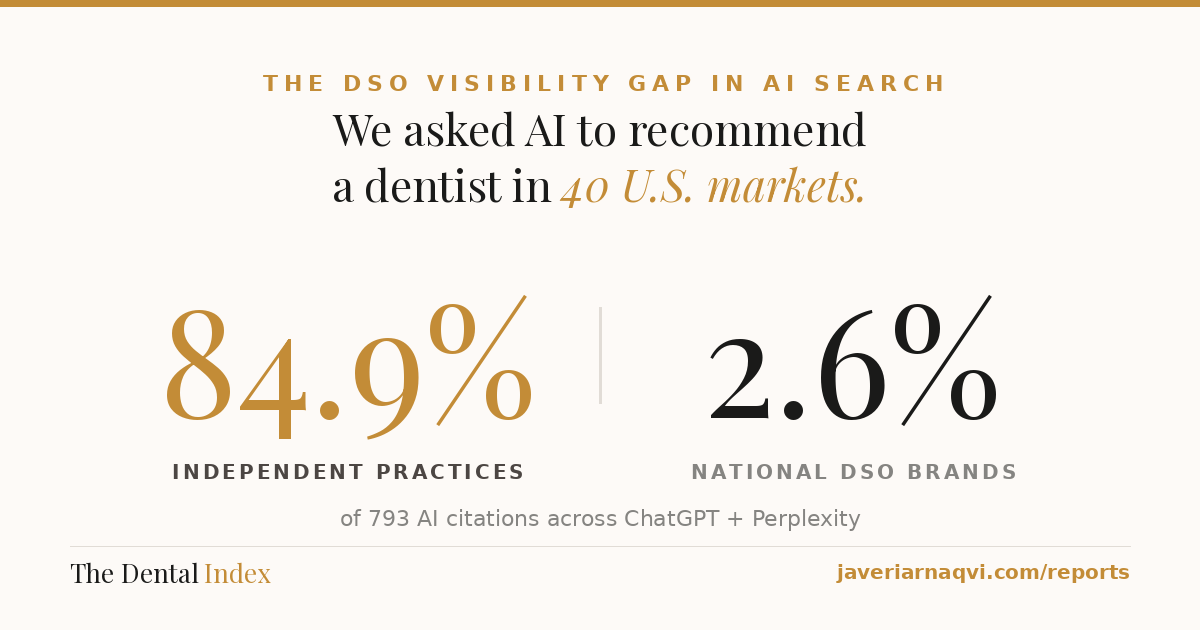
Every missed AI recommendation is a lost opportunity to become the practice a patient considers.
DSOs are not bad at marketing — they are the best-funded marketers in the field. But AI search has quietly become a front door to the practice, and it is walking new patients straight past it. A recommendation is not a booking — patients still compare, search, and ask around. But the consideration set now starts with the names the AI gives — and single-brand chain locations almost never appear in it: 20 citations out of 623, and none at all in 26 of the 40 markets.
Two AI engines (web-grounded ChatGPT and Perplexity), 40 U.S. markets chosen for high DSO density, 11 high-intent patient query types, 793 logged sources reduced to 623 citations to a practice’s own website, each matched against a list of national and regional single-brand chains. Full methodology and limits below.
The Bottom Line,
Up Front.
Three things a dental-group decision-maker needs from this study — what we found, why it is happening, and what it costs. The evidence follows in seven short chapters.
The Best-Funded Marketers in Dentistry
Had Never Been Measured.
Two trade reports established that DSOs lead the field in AI adoption. Neither asked the obvious follow-up: does AI recommend them?
In January 2026, Group Dentistry Now — the leading trade publication for the DSO industry — published "AI SEO for DSOs," framing the stakes plainly: a patient asks ChatGPT for a dentist, and your DSO either made that list, or it didn't. The piece noted that nearly 40% of younger patients now use AI tools for healthcare searches.
Four months later, Becker's Dental + DSO Review reported on a survey of 300 dentists finding that group practices and DSOs have the highest rates of AI adoption in the field — the biggest technology budgets, the dedicated IT teams, the most standardized workflows.
Put those two facts side by side and a question emerges that neither article answered: the organizations best-equipped to use AI internally — are they the ones AI actually recommends to patients? Nobody had measured it. So we did.
"A patient in Dallas types into ChatGPT: 'Which dental group has Saturday hours?' ChatGPT responds with three recommendations. Your DSO either made that list, or you didn't." — Group Dentistry Now, January 2026
Chains Won 3.2% of
AI Recommendations.
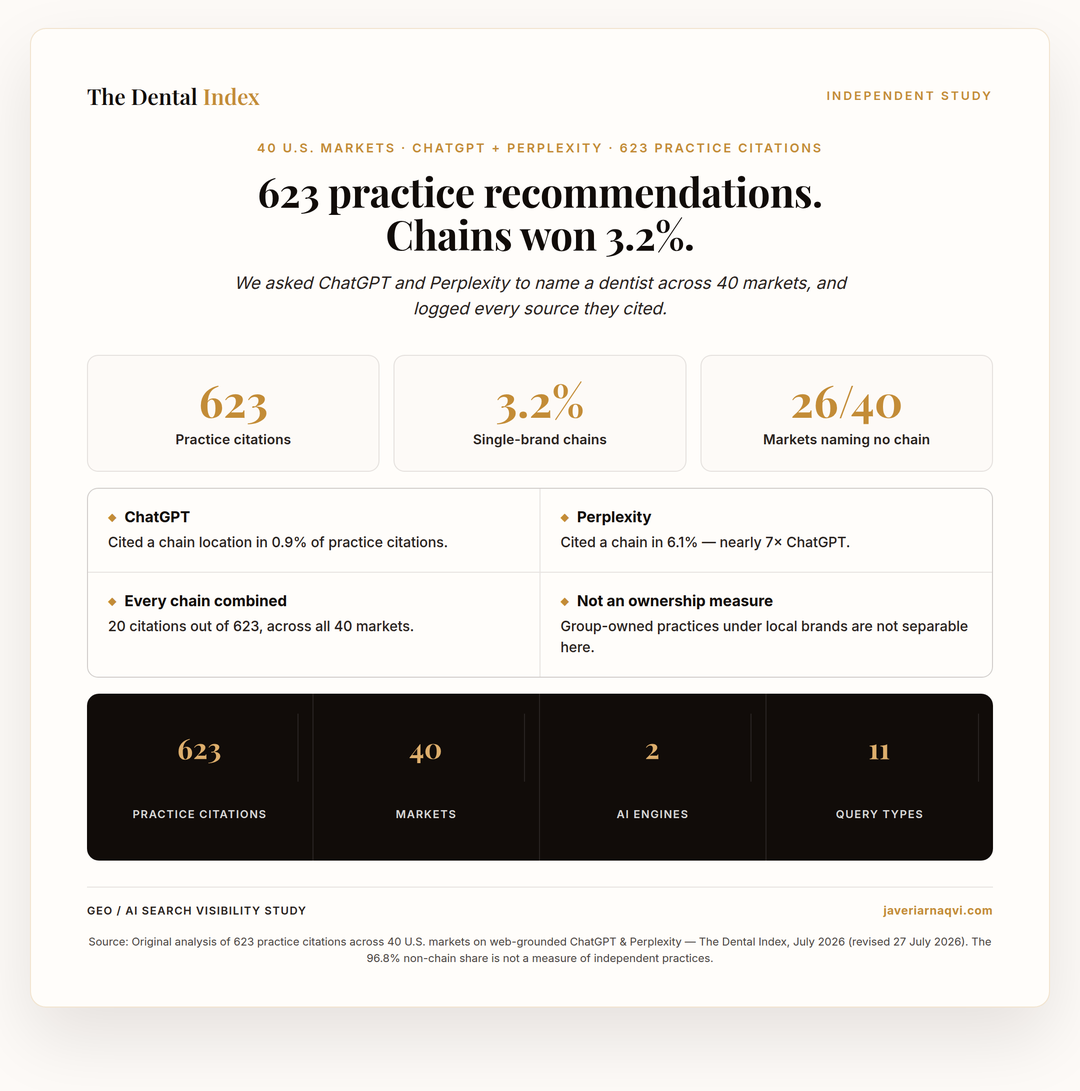
20 citations out of 623. The pattern held on both engines — and in 26 of the 40 markets, no chain was named at all.
Of the 793 sources logged, 170 were directories, aggregators, or insurers, leaving 623 citations to a practice’s own website. Single-brand chain locations took 3.2% of those. The pattern holds on both engines, with one revealing split: Perplexity cites chain locations nearly seven times as often as ChatGPT, driven almost entirely by a single brand. The remaining 96.8% is not a measure of independent practices — group-owned practices operating under local brands fall inside it and cannot be separated by this method.
| AI engine | Practice citations | Single-brand chain | Not a chain |
|---|---|---|---|
| ChatGPT (GPT-5.1) | 344 | 0.9% | 99.1% |
| Perplexity (Sonar) | 279 | 6.1% | 93.9% |
| Combined | 623 | 3.2% | 96.8% |
Filter out directories and forums, and look only at the citations that are an actual practice's own website: 96.8% of practice-website citations went to something other than a single-brand chain. That share is not the independent share: practices owned by brand-retained groups are counted inside it, and this method cannot separate them. What it does establish is that when AI names a dentist's own site, it is almost never a chain location.
Scale Did Not Earn Citations.
Specificity Did.
The 1,100-location chain was cited three times. A denture-and-implant specialist with a third of the footprint was cited thirteen.
Of 623 practice citations, single-brand chain locations earned 20. One category-focused brand — Affordable Dentures & Implants — earned more than half of them, almost entirely on Perplexity. The largest general-dentistry chains were nearly or entirely absent. Specificity, not scale, is what got cited.
| DSO brand | Estimated footprint | Citations (of 623) |
|---|---|---|
| Affordable Dentures & Implants | ~400+ locations | 13 |
| Aspen Dental | ~1,100+ locations | 3 |
| Monarch Dental | regional | 2 |
| ClearChoice | ~100+ centers | 1 |
| Castle Dental | regional | 1 |
| Mint Dentistry | regional | 1 |
| Western Dental, Bright Now!, Great Expressions, Sage Dental & 13 others | national / regional | 0 |
"Across 40 markets and 623 practice recommendations, every single-brand chain combined was named 20 times. The largest footprints in dentistry bought almost no visibility in the search surface that is replacing the map pack — while group-owned practices that kept a local name and a named doctor were cited freely."
AI Favors Earned Media.
DSOs Are Built on Owned.
This is structural, not a matter of effort or budget. The DSO content model is precisely the class of content AI underweights.
The reason is structural, and it is not about effort or budget.
AI answer engines are biased toward earned media — the opposite of what DSOs produce at scale. A September 2025 study running controlled experiments across verticals found that AI search exhibits "a systematic and overwhelming bias toward earned media (third-party, authoritative sources) over brand-owned and social content" — a sharp contrast to Google's more balanced mix. The DSO growth model is built on centralized, brand-owned web infrastructure: one content system, one templated location-page framework, service copy produced once and localized with a city name. That is precisely the content class AI underweights.
The signals AI rewards are the ones centralization flattens. Modern local ranking weights review recency and velocity, platform diversity, and per-provider, per-procedure structured data — not lifetime review count or domain size. A long-tenured independent with a steady drip of recent, procedure-specific reviews outperforms a newer templated location with a larger but staler footprint.
Being excellent at the old game does not transfer. Traditional Google rankings predict less than half of AI visibility. And unlike a ten-result page — where a DSO's dozens of location pages each catch a sliver of traffic — an AI answer returns a single shortlist of three to five names per market. In that format, "adequate everywhere" is no longer an asset. It is a liability.
Scale was the DSO's advantage. AI search inverts it.
For fifteen years, scale was the DSO's decisive edge in patient acquisition: centralization drove down the cost of every marketing task and let a group be present in 200 markets at once. AI search flips that logic. When the medium returns a handful of winners per market and selects on hyperlocal specificity and review freshness, a strategy optimized for breadth over depth is poorly matched to a channel that rewards depth in every market. The organizations best-equipped to use AI internally are, in this measurement, the ones AI search cited least.
The Gap Repeats at Every Location,
Every Month.
A citation is a patient at the moment of choosing. Miss it, and their shortlist starts without you.
A citation is not a vanity metric. It is a patient at a high-intent moment — they have decided to book, and they are asking an assistant who to trust. Not every recommendation becomes an appointment: patients ask more than one AI, Google afterward, and ask friends. But when the answer is a competitor's name, the shortlist that patient carries into all of those next steps starts without you.
And this is not a fringe channel. Nearly 40% of younger patients already use AI tools to find healthcare, and that share is compounding. A patient who arrives through an AI recommendation can be worth three who arrive through a paid ad — because the AI's pick reads as an unbiased endorsement, not an ad you bought.
"One patient who finds you through ChatGPT's recommendation can be worth three who find you through a Google ad." — Group Dentistry Now, on why AI recommendations convert
If AI grows into even a tenth of a location's new-patient discovery and a single-brand footprint wins 3.2% of it, you are structurally absent from the fastest-growing front door in dentistry. Across 50, 100, or 500 locations, that gap repeats at every location, every month — the dollar size depends on inputs worth modeling for your own group, like patient value and AI's share of discovery in your markets. What the structure guarantees is that ad spend cannot close it, because you cannot pay your way into an answer the AI presents as objective.
You Cannot Buy Your Way
Into an AI Answer.
AI search sells no ad slots. The one channel a group cannot outspend is the one it is least built for.
When a group watches patients slip to competitors, the reflex is to buy the visibility back with Google Ads. But paid search is the most expensive visibility in dentistry. In July 2026, one click on “dentist near me” cost $13.35, and “dental implants near me” ran $39.71, with top-of-page bids above $50 (DataForSEO). A click is not a patient. You pay for every one, at every location, every month, whether it books or not.
Set paid and earned visibility side by side and the instinct inverts under its own math.
| Measure | Paid search | Earned search |
|---|---|---|
| Click-through rate, top result | 2.1% | 39.8% |
| Visitor-to-patient conversion | 1.3% | 2.4% |
| Cost per customer acquired | $802 | $647 |
| Return over 36 months | 36% | 748% |
| When you stop investing | Visibility ends that day | Reviews and citations keep compounding |
Click-through, conversion, acquisition-cost and 36-month return: First Page Sage. Cost-per-click: DataForSEO, July 2026. Acquisition-cost and multi-year return are cross-industry benchmarks — they establish direction and order of magnitude, not a dental-specific guarantee.
The difference is what you own at the end. Ads are rent: stop paying and you disappear the same afternoon. Earned visibility is an asset that appreciates — the reviews, citations and AI recommendations a practice accumulates do not reset each month, they compound. And for dentists specifically, close to 6% of Google Business Profile views turn into a call, click or directions request, the highest conversion of any industry BrightLocal measured.
Ads buy attention only while the meter runs. Maps and AI visibility are the asset that keeps returning patients after the spend stops — and the only one AI search actually rewards.
This is exactly where the DSOs in this study are exposed. AI search — already the top provider recommendation for 26% of patients, with ChatGPT referral traffic up 206% year over year (rater8, 2025; Semrush, 2026) — does not sell ad slots. You cannot bid your way into the answer. The only way in is the asset: being the practice a real market already trusts. The organizations built to buy visibility are the least prepared for the one channel where visibility can only be earned — and where it compounds.
Five Shifts From Coverage
to Conviction.
The fix is not more technology. It is deciding to be the obvious choice somewhere, instead of an option everywhere.
The fix is not more technology. It is a shift in how a group thinks about being chosen. Patients don't book the biggest brand — they book the one that feels like theirs: local, specific, and recently vouched-for by people like them. AI simply mirrors that instinct back. Win the patient's conviction and the citation follows.
| Stop thinking… | Start thinking… | Why the patient — and the AI — rewards it |
|---|---|---|
| "Be everywhere" | "Be the obvious choice somewhere" | Patients pick conviction over coverage. Being an option in 200 markets loses to being the clear answer in one. |
| "We have the most reviews" | "We have the freshest reviews" | Trust is a recency signal. People book what someone like them chose last week — not what was praised five years ago. |
| "Corporate consistency" | "Local personality" | A practice that feels like a neighbor gets recommended. Sameness reads as anonymity — and no one refers the anonymous. |
| "Our brand" | "Their dentist" | Let each location earn its own reputation and voice. That felt sense of ownership is exactly what patients repeat and AI echoes. |
| "Market coverage" | "Patient conviction" | Stop counting locations; start counting who actually recommends you. That word-of-mouth is what AI now says out loud. |
The Study,
On One Card.
Chains won 3.2%.
Methodology &
Sources.
Engines. Web-grounded ChatGPT (GPT-5.1) and Perplexity (Sonar), queried via the DataForSEO AI Optimization API in July 2026, United States localization. Markets. 40 U.S. metropolitan areas selected for high DSO density, spanning every U.S. Census region — from Phoenix, Charlotte, and Columbus to Houston, Chicago, Seattle, and Memphis. Queries. Eleven high-intent patient query types phrased the way patients phrase them (dental implants, cosmetic / veneers, emergency, Invisalign, family / general, pediatric, root canal, teeth whitening, dentures, and "best dentist"). Classification. Of 793 logged source URLs, 170 were directories, aggregators, or insurers and are excluded, leaving 623 citations to a practice’s own website. Each was matched against a list of national and regional single-brand chains. This match is exhaustive for that category and has no false negatives, because every location of such a chain carries the corporate brand in its domain. It cannot detect any other form of group ownership.
Scope & notes. This study covers web-grounded ChatGPT and Perplexity; Google AI Overviews triggered inconsistently through the API during collection and were excluded. What this study does not show. It does not measure DSO ownership. The dominant DSO model does not rebrand: Heartland Dental supports 1,700+ offices under local names, MB2 Dental is built on doctors retaining their brand, and specialty platforms such as Imagen Dental Partners and Allied OMS keep the practice name and the named doctor. Every such practice is scored here as “not a chain.” The independent share is therefore below 96.8% by an amount this method cannot determine, and any claim about it would be a guess. Separating brand-retained group ownership from genuine independence is the next phase of this research.
Data & sources. Paid-search costs are live U.S. Google Ads cost-per-click values (DataForSEO, July 2026). The channel-share, click-through, conversion, acquisition-cost, and ROI benchmarks in this report are drawn from published research — attributed inline where cited, with the full reference list in the page footer. Cross-industry benchmarks (e.g. acquisition cost and multi-year ROI) are labeled as such — they establish the direction and order of magnitude, not a dental-specific guarantee. Read the full research methodology →
The Dental Index. The Single-Brand Visibility Gap in AI Search: 623 Practice Recommendations Across 40 U.S. Markets. July 2026. javeriarnaqvi.com/reports/dso-ai-search-visibility
Media and researchers: the full market-by-market dataset and methodology are available on request. We accept no sponsorship for our research reports — findings are what the data says.
Free to republish with attribution. Paste this where you want the stat card to appear — it renders on any site and links back to the full study.
Want to Know What This
Is Costing You?
This study is built by the same engine I run for consulting clients. For dental groups, multi-location practices, and DSOs, I turn it on your brand and markets: which patients AI is handing to competitors at every location, a brand-by-brand and engine-by-engine benchmark, competitor threat maps, and a 90-day roadmap to win them back. The AI Visibility Diagnostic is scoped per market and credited toward any engagement.
See How Many Patients
You're Losing to AI.
This is the market at large. We can run the same measurement on your group or DSO — every location, every engine — and show you exactly which patients are being handed to competitors, and what it's costing you.
Run Your AI Visibility Audit →Prefer the data first? Request your county's free demand report →
Independent research from The Dental Index · Published July 2026