A 4.9-Star Practice,
Invisible on the Map.
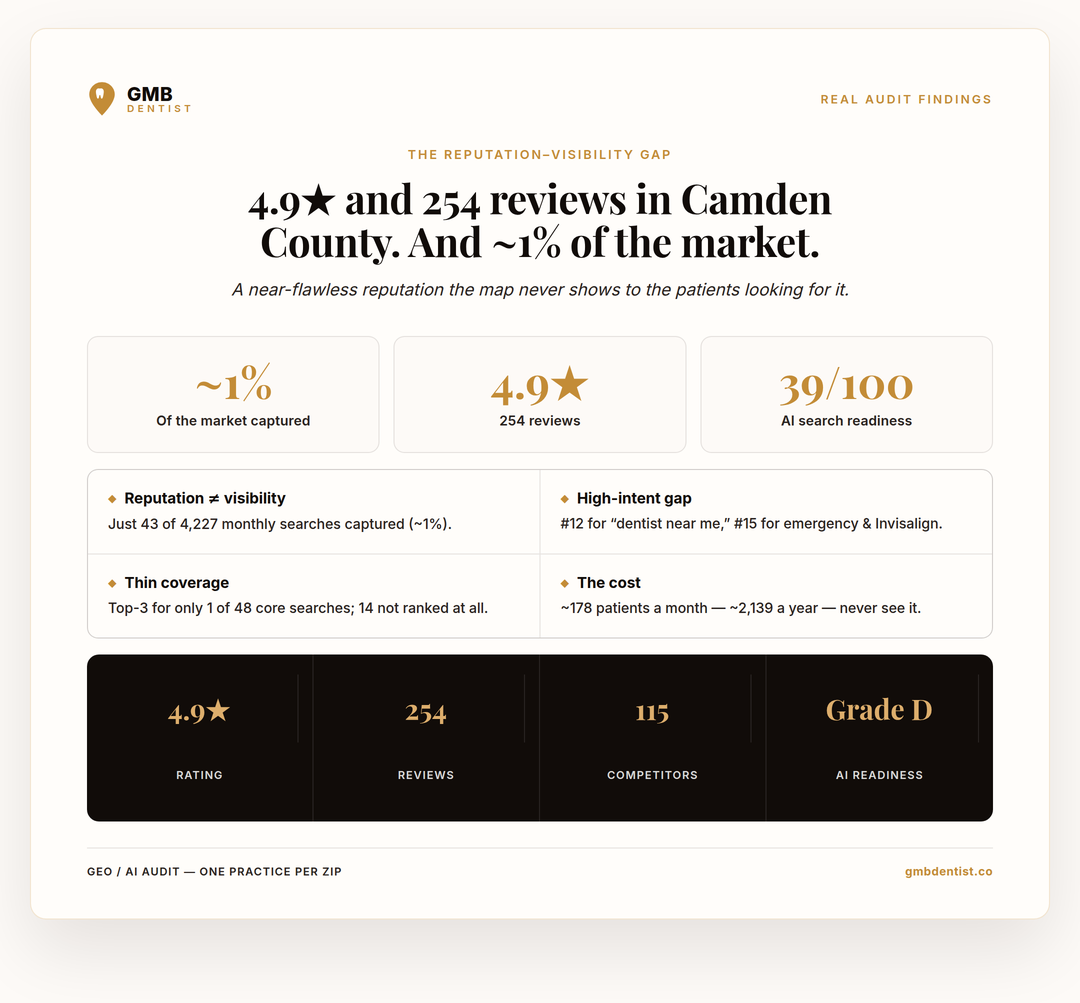
This practice has done the hardest part. 4.9 stars across 254 reviews — a reputation most practices spend a decade building. And yet it captures roughly 1% of the dental demand searching in its own county, because on the searches that actually drive patient volume, it barely appears. The reviews are elite. The visibility is a Grade D.
A Reputation Nobody
Can Find.
Most audits open with a practice that has a visibility problem and a reputation problem. This one is different, and more instructive. On reputation, this practice is in the top tier of its entire market: 4.9 stars, 254 reviews. Patients who reach it, love it. The trust is already earned.
But trust only matters once you're in the search result — and this practice mostly isn't. It ranks in the top three for just 1 of 48 service searches, and not at all for 14 of them. Its strongest positions cluster in low-volume niches — #3 for "smile makeover," #4 for "tmj mouth guard," #5 for cosmetic and single-tooth-implant terms. On the searches that carry the county's actual volume, it drops out of view.
"A 4.9-star reputation earns the click. But this practice is only in the room for the searches patients make least — and missing from the ones they make most."
That inversion — strong where demand is thin, weak where demand is thick — is the Demand Mismatch, and here it sits on top of an elite reputation. The table below pairs each service category with the practice's Google Maps position on that category's highest-volume search.
| Category | Top county search | Practice position | Read |
|---|---|---|---|
| General / Preventive | "dentist near me" | #12 | Largest single term in the county — barely visible |
| Emergency | "emergency dentist near me" | #15 | High-urgency demand, largely missed |
| Pediatric Dentistry | "pediatric dentist near me" | — | No visibility on any children's term |
| Orthodontics | "invisalign near me" | #15 | Invisible on braces & clear aligners |
| Implants | "dental implants near me" | #7 | Mid-pack on a core service line |
| Dentures | "dentures near me" | #9 | Mid-pack — present but not competitive |
| Cosmetic | "teeth whitening near me" | #11 | Weak on the top cosmetic term; #3–#5 on smaller ones |
| TMJ / Jaw Pain | "tmj mouth guard" | #4 | Its best rank — on one of its lowest-demand terms |
Position shown is the practice's Google Maps rank for the highest-volume keyword in each category. Green = top 3 · amber = 4–9 · red = 10+ or unranked.
General / Preventive and Emergency are the two largest demand pools in Camden County — and they are exactly where this practice sits at #12 and #15. The rankings it does own (#3–#5) live in cosmetic and niche implant terms that carry a fraction of the searches. Elite reviews cannot rescue a listing that never enters the result.
The Same Gap,
on the Next Channel.
An estimated 18% of dental searches now run through AI engines before a patient ever opens Google Maps. The practice's review authority carries it on the engines that weight reviews heavily — Perplexity, ChatGPT — but it fades on the largest and fastest-growing channels, the ones that pull from Maps rank and listings the practice hasn't claimed.
Google AI Overviews — the single largest AI channel at 42% of AI dental searches — pulls directly from the local Map Pack, so the same General / Preventive and Emergency ranking gaps above suppress the practice here too. The two weakest engines, Bing Copilot and Siri / Apple Intelligence, both draw on listings most dental practices never claim (Bing Places, Apple Business Connect).
Across all engines, the audit estimates the practice captures roughly 4.1 of 8.2 AI-referred patients available each month — an AI gap of about 4 patients/month (≈49/year), growing an estimated 35% a year as AI search share rises.
What the Silence
Is Worth.
Translate the weakest, highest-demand categories into patients and the scale becomes clear. These are modeled estimates — they apply position-based click-through rates and category conversion assumptions to live search volume — but they size the opportunity. Across the categories the practice already competes in, the audit models roughly 178 patients/month (~2,139/year) going elsewhere.
| Category | Est. patients lost/mo | Modeled revenue/mo |
|---|---|---|
| General / Preventive | 96.2 | ~$26,933 |
| Emergency | 57.9 | ~$26,042 |
| Pediatric Dentistry (untapped) | 16.5 | — |
| Orthodontics | 7.1 | — |
| Cosmetic | 6.6 | — |
Revenue figures are modeled estimates based on category-specific conversion rates and an average case value; they are not booked revenue. Patient-loss figures are CTR-adjusted from live Google Maps positions, consistent with the audit's Patient Gap Analysis. Pediatric Dentistry is an untapped category — the practice has zero current visibility across all six children's-dentistry searches.
The Hard Part
Is Already Done.
This is not a struggling practice. Five-star care, 254 reviews — that's the part most practices never finish, and this one has. The gap here is purely visibility: the practice has earned the trust but never enters the search result where that trust could convert.
The fix is not more reviews or a new website. It's re-pointing earned authority at demand: moving into the General / Preventive, Emergency, and Pediatric searches that carry Camden County's volume, and claiming the Bing and Apple listings that unlock AI search. That is exactly what the Demand Capture System is built to do.
A practice patients love is invisible to the patients still searching. When reputation is this strong and capture is this low, the entire gap is visibility — and visibility is the fixable part.
The Audit,
On One Card.
County. And ~1% of the market.
Methodology &
Sources.
Rankings are pulled live from Google Maps across 48 dental service keywords for the practice's location in Camden County, NJ. Search volumes are live DataForSEO data scaled to the county population. The AI & Maps score (39/100) weights Maps top-3 rankings (40%), top-10 coverage (25%), service breadth (20%), review authority (10%), and rating (5%) — this practice scores full marks on rating and review authority but near-zero on top-3 rankings, which is what drags the composite to a Grade D. AI engine scores are modeled estimates based on Maps rank, review authority, and rating signals — not live AI engine queries. Patient and revenue figures are modeled from CTR and category conversion assumptions and are labeled as estimates throughout.
The practice is anonymized at the practice's level of identification; market context is reported at the county level. All figures reflect a current-state snapshot at the time of analysis (June 2026) and shift over time. This audit uses publicly observable data only and represents an independent assessment, not an engagement or a produced result. Read the full research methodology →
See Your Own
Demand Mismatch.
This is the same audit, run on your practice and your county. It maps your demand, scores your Maps and AI visibility, and shows exactly which searches you're missing. Takes 2 minutes.
Run an Audit on Your Practice →Free. No agency. Just the data on your market.