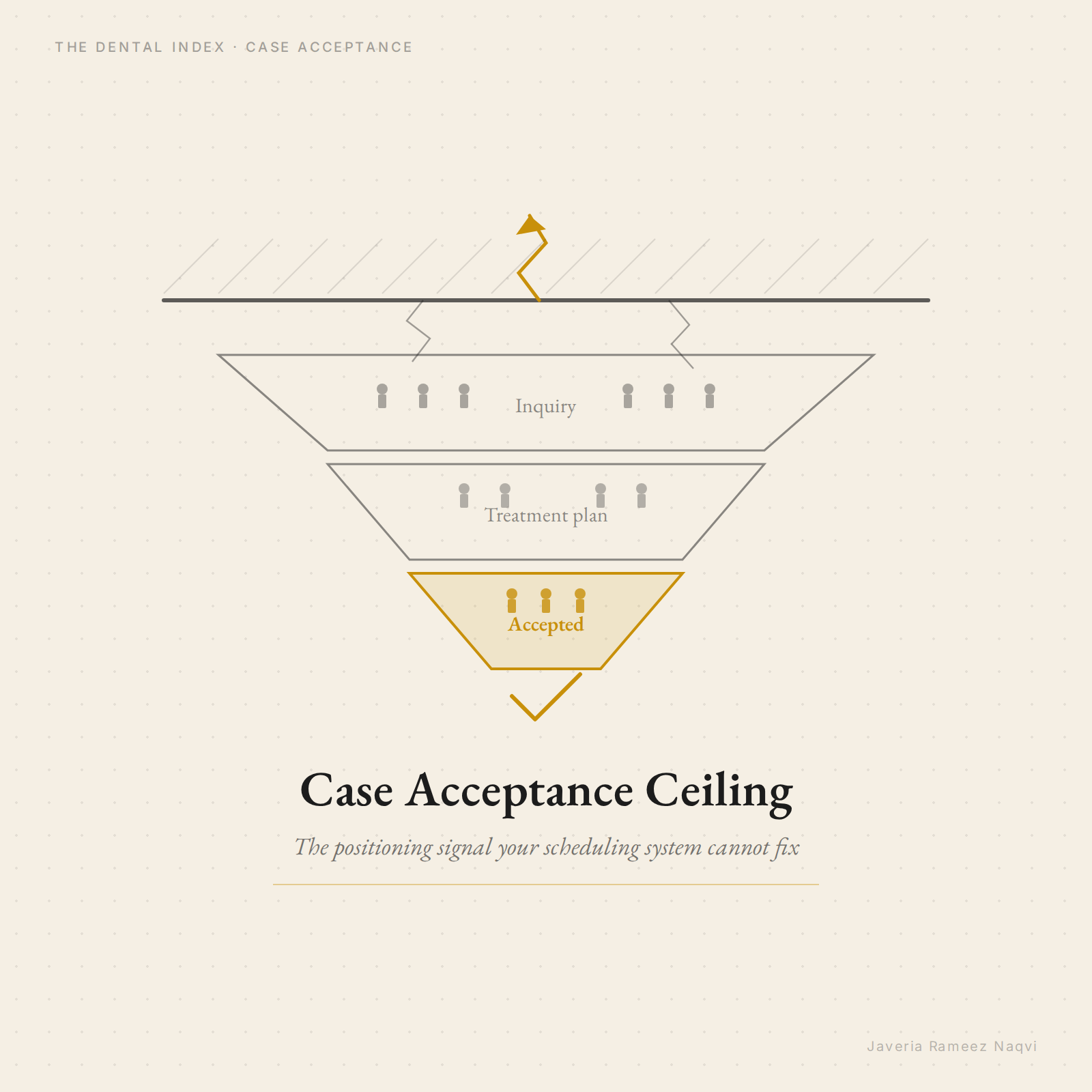
Consider a practice like this one, a pattern that appears repeatedly across The Dental Index data. Dr. Julian Chen has fourteen years in practice in Denver. Full hygiene schedule. 42 Google reviews at 4.8 stars. Competitive fees. His restorative case acceptance sits above 80%. His implant case acceptance has sat at 37% for three years running. He tried longer consultations, better imaging, new scripts, and financing options. The number did not move. The ceiling was never clinical. The patient decided what they were willing to invest in his practice before they ever sat down. If your high-value case acceptance has plateaued no matter how hard you work the presentation, you may be looking at the same pattern.
The ceiling is real, and it is not in his treatment room. Dr. Chen is good at presenting, and his restorative acceptance proves it. When a patient already trusts that a crown is normal, expected dentistry, he closes it without effort. Implants are different. The patient has to decide his practice is the right place to spend $4,500, and they decide that long before the consultation.
No scheduling tool, follow-up sequence, or payment option can rewrite a decision the patient already made. That is why the number did not move. He was working on the last ten minutes of a decision that was settled in the first ten seconds of research.
Why Does Your Case Acceptance Keep Hitting the Same Number?
Treatment planning software cannot explain the gap. Neither can your front desk scripts. When you examine revenue per chair hour across solo practices at comparable fee tiers, a consistent and unexplained spread appears. Some practices running full schedules generate far more per productive hour than others with nearly identical clinical output. The difference shows up upstream, in how patients perceive the practice before they arrive. Every patient walks in carrying a mental budget that was set while they researched you, and your case presentation rarely breaks through a ceiling that was set before they parked the car.
This is the trap that makes the problem so frustrating. You assume that because the conversation happens at chairside, the fix lives at chairside. So you sharpen the part you can see. You add visuals. You rehearse the financing options. And the number stays exactly where it was, because you are polishing the one part of the process that was never the bottleneck. This is the central tension in case acceptance in solo practices: the appointment is where you see the result, not where the result is decided.
What Is Actually Setting the Ceiling Before the Patient Arrives?
Three things set a patient's willingness to invest before they ever speak to you. None of them happen in the operatory.
- Unanchored trust. The patient found you through a generic channel and has no specific reason to choose you over any other dentist within five miles. Your implant recommendation reads as something to verify elsewhere before committing. They are not declining. They are deferring while they look for a reason to feel sure.
- Price without context. The patient hears a number before they have been given any reason to believe your practice is worth it. Price without positioning reads as expensive. The same price after a clear positioning signal reads as fair, sometimes even as a relief.
- Generic discovery. The patient booked because you had an opening, came up in a broad map search, or showed up in an insurance directory. Nothing told them you are known for the exact thing they need. They arrive neutral, and neutral patients leave uncommitted.
The patient who walks in for an implant consult and says they need to think about it is almost always in one of these three states. The data shows what that costs you. Practices where high-value patients arrive with a specific prior impression accept implant and cosmetic treatment at far higher rates than practices where those same patients arrive through generic channels, even at identical fees.
| How the High-Value Patient Found You | Implant/Cosmetic Acceptance | Revenue per Chair Hour | Pattern |
|---|---|---|---|
| Positioned: found you through a specific treatment search, AI recommendation, or procedure-specific review | 62-67% | 40-60% higher | Pre-sold on the practice, fee evaluated against credibility |
| Unpositioned: found you through an insurance directory, broad map search, or generic listing | 30-37% | Baseline | High deferral, frequent discount requests, slow follow-up |
| Mixed: some prior signal, no clear identity | 44-50% | Slightly above baseline | Inconsistent, varies patient to patient |
Source: The Dental Index national practice audit · 2026
Look at where your last 30 high-value consults came from. If most arrived through generic channels, your implant acceptance ceiling is already set before you say a word. That is why Dr. Chen's 37% would not move. His patients were arriving through the channels that produce a 37%, and no amount of chairside skill rewrites the band a patient walks in with.
Your fees are not the problem. Your positioning is not telling the patient the fee is worth it before they arrive.
Who Is the Patient Who Arrives Ready to Invest?
The patient who accepts a $4,500 implant case on the first visit did not decide in your chair. They decided over several days, on their phone, before they called.
Patients considering treatment above $3,000 do real research first. They read reviews, look at before-and-after photos, and search the procedure name and their city. In 2026 a growing share of that research happens inside AI search. By the time this patient books, they are not shopping. They are confirming a practice they already chose in their head, and the appointment exists to ratify that choice.
Contrast that with the patient who found you because you take their insurance and had a Thursday opening. They did no procedure research. They have no mental picture of you as an implant practice. When you present the case, you are not confirming a decision. You are starting one from zero, against the natural instinct to wait and get a second opinion. Same chair, same dentist, same fee. Completely different starting line.
What Do the Practices Getting This Right Do Differently?
They do not have better closers. That is the first myth to drop.
The solo practices that close high-value cases at 60% and above share one structural feature: their patients arrive already wanting the specific treatment, from the specific practice. The clinical conversation confirms a decision instead of trying to create one. They built that by getting three things consistent.
- A single clear identity. The practice is known for one specific thing. Implants. Full-arch. Cosmetic transformations. Anxiety-free care. A patient searching for that thing finds them and arrives already wanting what they offer. A generalist signal attracts generalist patients with generalist budgets.
- Procedure-specific proof. Not just five stars. Reviews and photos that name the exact treatment and the outcome. A review that says "I finally did my implants here after putting it off for years" pre-sells the next implant patient in a way a "great dentist, highly recommend" never can.
- Visibility where the decision happens. When a patient asks Google or ChatGPT who does the best implants in their city, these practices appear. The unpositioned practice down the street does not, no matter how good its dentistry is.
AI-referred patients book high-value procedures at two to three times the rate of patients from other channels. Not because AI sends better patients, but because the patient who used AI to find a specific implant practice had already decided to do the implant. They used AI to choose where, not whether. Your practice either shows up at that moment or it does not.
What Separates the Practices That Fix This From the Ones That Don't?
It is not effort. The owners stuck at the ceiling are usually working harder than the ones who broke through it.
The difference is how they define the problem. The stuck practice treats low high-value acceptance as a chairside performance issue, so it keeps investing in the presentation: more training, more visuals, more financing menus. The practice that breaks through stops treating it as a closing problem and starts treating it as a positioning signal problem. They ask a different question. Not "how do I present this case better?" but "what did this patient believe about us before they sat down, and where did that belief come from?" Once you accept that the case was mostly decided before the visit, you stop pouring effort into the last ten minutes and start building the days of research that come before them.
This is also why marketing spend alone rarely fixes it. You can buy more traffic, but if every patient who arrives sees a practice that could be any practice, you are paying to fill the chair with the same uncommitted patient. Positioning is what makes the marketing convert. Without it, every channel works harder for a smaller return.
Decide what one treatment your practice will be known for
A patient who arrives knowing you are the implant practice has already pre-qualified themselves. They are not comparing you to the generalist down the street, they are confirming the choice they made before they called. When you are known for everything, you are pre-sold for nothing, and every high-value patient arrives in the deferral band instead of the acceptance band.
Make your highest-value patient see themselves before they book
The patient considering full-arch or veneers needs to recognize their own situation in what they find: the case like theirs, the fear like theirs, the outcome they want. When they see it, they arrive believing you understand their specific problem, and belief is what collapses the deferral. When they find only generic "we care about smiles" language, nothing tells them you have solved a case like theirs, so they leave to keep looking.
Let your patients describe the procedure for you
A future implant patient trusts a past implant patient more than they trust your website. When your reviews name the exact treatment and the relief that followed, the next patient arrives expecting that outcome and expecting to pay for it. When your reviews only mention friendly staff and short waits, the high-value patient has no proof you do the work they need, so the fee feels like a gamble.
Match what you charge to what your signal promises
When a patient researches a practice that clearly specializes in a procedure, a higher fee reads as confirmation of authority, not as a red flag. When the same fee sits on a practice that looks like every other office, it reads as expensive and the patient starts shopping. Raising your fee without raising your positioning invites the second reaction. Raising both together attracts the patient who expected to pay it.
Be present at the exact moment the decision is made
The high-value decision now happens inside a search bar days before the appointment. When a patient asks an AI assistant or Google who handles their procedure in their city, the practice that appears gets to be the one they confirm in their head. The practice that is invisible at that moment is never in the running, no matter how strong its clinical results. You cannot close a patient whose decision was made before they ever found you.
Read your own signal the way a stranger would
The patient who has never heard of you forms an impression in seconds. If a stranger cannot tell within ten seconds what you are specifically known for, neither can the patient about to decide where to spend $4,500. Looking at your practice as that stranger would, with no prior loyalty and a real decision to make, tells you exactly what belief your high-value patients are walking in with.
How Long Before You See the Difference in Your Numbers?
This is not an overnight change, and you should be suspicious of anyone who promises it is. You are changing which patients find you, which changes which patients sit down pre-sold, which changes your acceptance band. That chain takes time to register. Patterns in the data suggest practices that sharpen their positioning signal begin seeing a shift in who arrives within two to three months. The acceptance rate on high-value cases usually shows a measurable change around the six-month mark, then compounds as the new patient mix stabilizes.
The shift is structural, not sudden. Once the patient who already wants implants is the one finding you, your acceptance rate on implants reflects that. You are not learning to close harder. You are changing the starting line so that closing barely has to happen. That is a more durable gain than any script, because it does not depend on you performing at chairside.
What Changed for Dr. Chen
A year after Dr. Chen stopped treating his 37% as a presentation problem, the pattern in his numbers had shifted.
He picked one identity: implants. He said it everywhere a patient might find him.
He asked every implant patient to describe their case in their own words.
He found out where his practice stood when a patient searched for implants in Denver, and he closed the gaps that were keeping him invisible.
His implant acceptance moved out of the thirties. His average case value rose. His schedule was no fuller than before.
He had not become a better closer. He had stopped seeing the patients who were never going to say yes to the cases he was built to do. If your high-value acceptance is stuck the way his was, the fix is the same, and it starts before the patient sits down.
Where Your Positioning Actually Reaches the Patient
Here is where the positioning problem becomes a visibility problem. In 2026 they are the same problem wearing two names.
Your sharpest positioning is worthless if the patient never sees it. The place high-value patients now look first is AI search and Google Maps. The audit found that 70% of solo practices are invisible to those AI-referred patients, and that 82% of dental searches end in a Maps interaction. If your implant identity is not legible to the systems answering those questions, the patient most ready to say yes finds the practice that made its signal readable instead of yours.
This is the same root cause behind the overhead gap documented in why practices ranking for high-value procedures pay less overhead. Low visibility, low high-value mix, and a stuck acceptance ceiling are three symptoms of one condition: a positioning signal too weak for the patient to find and trust before the appointment. Fix the signal and all three move together.
You have spent years building a practice worth choosing. The only question that matters now is whether the patients who would choose you can find you at the moment they decide. Find out exactly where your practice shows up in AI search and Google Maps, and you will know precisely where your case acceptance problem really begins.