One Playbook.
Three Different Leaks.
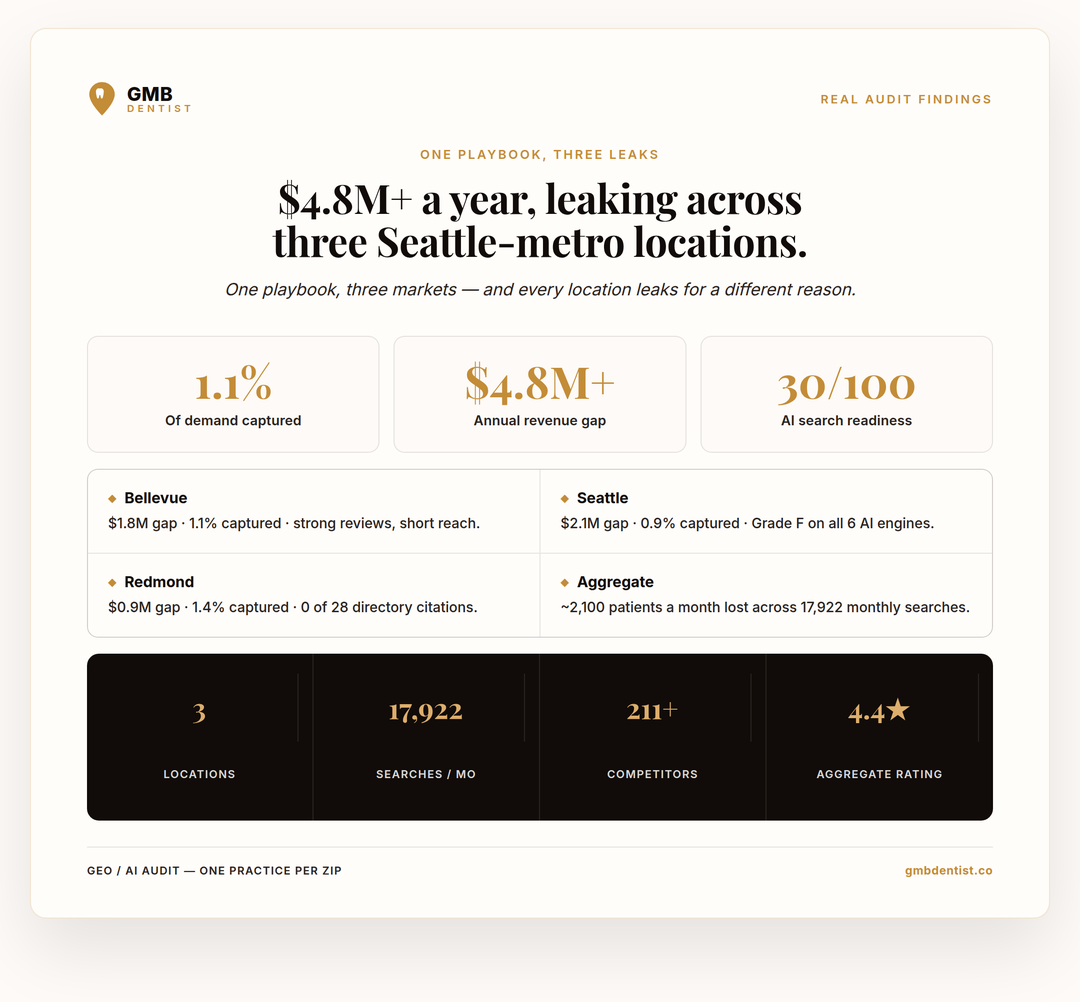
This is our first multi-location group case study — a three-location dental group spread across Bellevue, Seattle, and Redmond. Together the three locations capture just 1.1% of the 17,922 high-intent searches moving through their metro every month. But the headline number hides the real lesson: the group ran one marketing playbook across three different cities, and every location was leaking revenue for a different reason.
One Playbook Run
Across Three Cities.
Bellevue, Seattle, and Redmond sit within the same metro, but they are not the same market. They have different patient demographics, different service demand, and different sets of competitors. This group treated them as one — the same marketing playbook, the same positioning, the same priorities at all three addresses — and no single location was optimized for the local demand actually searching around it.
The result is the pattern that plays out across almost every group we audit: each location loses a different amount, for a different reason. Bellevue and Redmond leak the least; Seattle — the group's highest-demand market — was the least optimized and bled the most. Of the 17,922 high-intent searches moving through the metro each month, competitors capture roughly 81%, another ~17.9% goes uncaptured entirely, and the group holds just 1.1%.
"One playbook across three cities wins one market and quietly leaks the other two. Every location is a different local market — and has to be optimized like one."
| Location | Local demand captured | Annual revenue gap | The leak |
|---|---|---|---|
| Bellevue, WA | 1.1% | $1.8M | Known and reviewed, but visible for almost none of its own service lines |
| Seattle, WA | 0.9% | $2.1M | Highest-demand market, least optimized — the single biggest leak |
| Redmond, WA | 1.4% | $0.9M | Strong reputation, but visibility concentrated in a couple of services |
Local demand captured and annual revenue gap are drawn from the group's strategic snapshot across the three cities. Revenue figures are modeled estimates based on category-specific conversion rates and average case value; they are not booked revenue.
This is the definitive example of the Demand Mismatch — the gap between what a market's patients are searching for and what a practice is actually visible for. It is no accident this shows up on a group: the Demand Mismatch first surfaced in exactly this kind of multi-location audit, where locations in different markets were all optimized identically, ignoring that each had different demographics and different service demand.
Why Each Location
Leaked Differently.
Run the same audit on each address and the diagnosis changes every time. The playbook that produced a passable result at one location produced a different failure at the next — because the underlying market was different and the strategy never adjusted for it.
| Location | Google reviews | Top-3 of 42 | Not ranked | The specific failure |
|---|---|---|---|---|
| Bellevue, WA | 257 | 2/42 | 25/42 | Reputation without reach — live on Maps for only 3 of 7 service lines |
| Seattle, WA | 47 | 4/42 | 16/42 | Highest demand, thinnest authority — all six AI engines score Grade F |
| Redmond, WA | 137 | 3/42 | 24/42 | Strong reviews, narrow visibility — in the top 10 for just 4 of 42 searches |
Rankings are the practice's live Google Maps positions across 42 dental service keywords per location. Green = top 3 · amber = mid-pack · red = 8+ or unranked. Review counts are live Google Business Profile figures at the time of analysis.
Seattle is the tell. It is the group's largest single market — "dentist near me" alone runs into five figures of monthly searches there — yet it carries the thinnest review authority of the three (47 reviews) and scores Grade F on every one of the six AI engines (18–34/100). The most demand, pointed at the least-optimized listing. That is why the biggest revenue gap, $2.1M, sits on the location most operators would assume was fine.
Invisible on AI,
Group-Wide.
An estimated 18% of dental searches now run through AI engines before a patient ever opens Google Maps. Across the three locations, the group averages a 30/100 aggregate AI & Maps score — Grade F. The engine-by-engine picture below is the mean of the three locations' modeled scores; Seattle's all-Grade-F profile drags the group down on every channel.
Google AI Overviews — the single largest AI channel at 42% of AI dental searches — pulls directly from the local Map Pack, so the same top-3 ranking gaps documented above suppress all three locations here too. The two weakest engines, Bing Copilot and Siri / Apple Intelligence, draw on listings the group never claimed: the directory audits found 1 of 28 citations at Seattle and 0 of 28 at Redmond — Bing Places and Apple Business Connect included, at every address.
AI search share is growing an estimated 35% a year. A group that is invisible on these channels at three locations isn't behind by one gap — it's behind by three, and the gap widens with every location added under the same unclaimed-listing playbook.
What Three Leaks
Add Up To.
Translate the uncaptured demand into patients and dollars and the group-level scale becomes clear. These are modeled estimates — they apply position-based click-through rates and category conversion assumptions to live search volume — but they size the opportunity. Every month, roughly 17,700 high-intent searches go to competitors and another 3,200 go completely untapped across service lines and neighborhoods no location is optimized for.
| Location | Local demand captured | Modeled annual revenue gap |
|---|---|---|
| Seattle, WA (biggest leak) | 0.9% | ~$2.1M |
| Bellevue, WA | 1.1% | ~$1.8M |
| Redmond, WA (smallest leak) | 1.4% | ~$0.9M |
| Group aggregate | 1.1% | $4.8M+ |
Revenue figures are modeled estimates based on category-specific conversion rates and an average case value; they are not booked revenue. Patient-loss figures are CTR-adjusted from live Google Maps positions, consistent with the audit's Patient Gap Analysis. The aggregate gap compounds: it is not a fixed number but grows with each additional location run on the same undifferentiated playbook.
Every Location Is Its Own
Local Market.
There is nothing wrong with this group clinically. Three locations, hundreds of reviews between them, a recognizable name across the metro. The problem is strategic: a group scales its playbook faster than it scales its market intelligence, and ends up optimizing three different cities as if they were one. Busy doesn't mean profitable — and three busy locations can still leak $4.8M a year in demand they never see.
The fix is not more locations or a bigger brand. It's optimizing each location for its own local demand: the demographics, the service mix, and the competitors that are actually specific to Bellevue, to Seattle, and to Redmond — and claiming the Bing and Apple listings that unlock AI search at every address. That is exactly what the Demand Capture System is built to do, and it is the through-line of the multi-location audit that started everything.
If you run two or more locations, the leak in this case study is almost certainly running in yours — quietly, at every address, in a different way. Javeria works with dental groups and DSOs to optimize each location for its own market instead of a portfolio average.
For groups & DSOs: work with Javeria →A group that runs one playbook across three markets wins one and leaks the other two. The moment you add a location, you add a market — and a market you don't optimize for is a market you fund for your competitors.
The Audit,
On One Card.
three Seattle-metro locations.
Methodology &
Sources.
Rankings are pulled live from Google Maps across 42 dental service keywords for each of the three locations in the Seattle metro. Search volumes are live DataForSEO data scaled to the local market. The aggregate AI & Maps score (30/100) weights Maps top-3 rankings (40%), top-10 coverage (25%), service breadth (20%), review authority (10%), and rating (5%), reported across the group. AI engine scores are modeled estimates based on Maps rank, review authority, and rating signals — not live AI engine queries; the engine grid shown is the mean of the three locations' scores. Demand-capture, patient, and revenue figures are drawn from the group's strategic snapshot and modeled from CTR and category conversion assumptions, and are labeled as estimates throughout.
The group is anonymized at the practice level; market context is reported at the city and metro level. All figures reflect a current-state snapshot at the time of analysis (June 2026) and shift over time. This audit uses publicly observable data only and represents an independent assessment, not an engagement or a produced result. Read the full research methodology →
See the Leak at
Every Location.
This is the same audit, run on each of your locations and each of their markets. It maps local demand, scores every location's Maps and AI visibility, and shows exactly which searches each address is missing. Takes 2 minutes per location.
Free. No agency. Just the data on your markets.