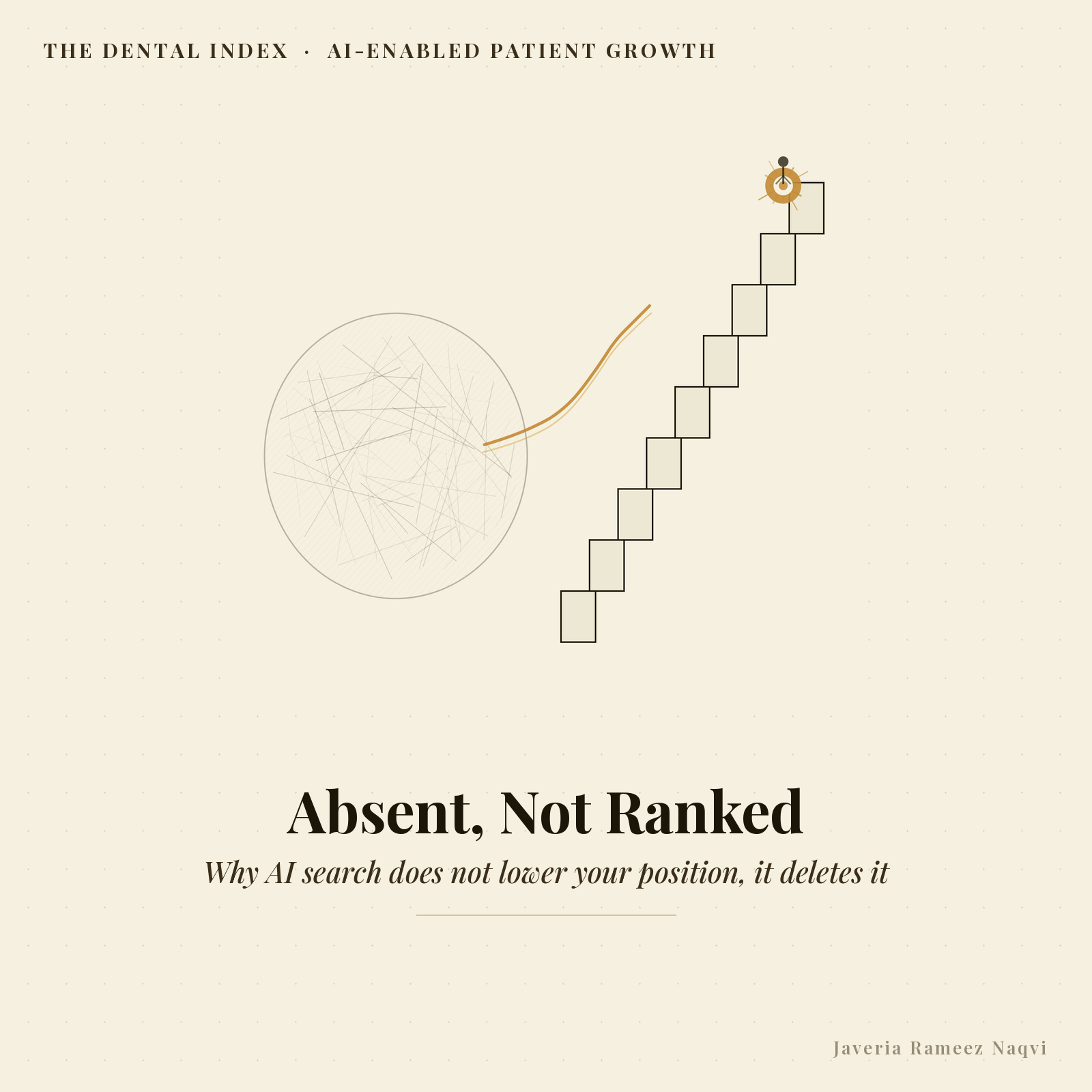
Consider a practice like this. Dr. Elena Ruiz runs a well-reviewed solo office in Tucson, twelve years in, with a schedule that used to fill itself. This spring her new patient calls thinned out, and not because her reviews slipped or a competitor opened nearby. When she typed her own city and "best dentist for implants" into ChatGPT, three practices came back by name, and hers was not one of them. Her star rating was higher than all three. That is the moment this article is about: the day you realize the question is no longer where you rank, but whether you exist in the answer at all.
Consider a practice like this. Dr. Elena Ruiz runs a well-reviewed solo office in Tucson, twelve years in, with a schedule that used to fill itself. This spring her new patient calls thinned out, and not because her reviews slipped or a competitor opened nearby. When she typed her own city and "best dentist for implants" into ChatGPT, three practices came back by name. Hers was not one of them. Her stars were higher than all three. That is the moment this article is about: the day you realize the question is no longer where you rank, but whether you exist in the answer at all. If that moment feels familiar, keep reading, because the distinction underneath it changes everything.
What actually happens when a patient asks ChatGPT for a dentist near them?
When a patient opens ChatGPT and types "dentist near me who is good with nervous patients," something different from a Google search happens. There is no page of ten blue links to scan, no map pack to compare. The engine returns a short list, often three names, sometimes one, phrased as a recommendation rather than a directory. Around 432,000 of these AI-driven dental searches now happen every month, and the number climbs each quarter. Your practice is either named in that answer or it is invisible for that patient, and there is no second page to be relegated to. The patient does not know you were close. They do not know you exist. For a solo owner this is the uncomfortable part: the patient who would have loved your chairside manner never learns your name, because the machine that answered them never mentioned it. You did nothing wrong that day. You simply were not in the shortlist the engine had already decided to read aloud.
Why does a Google update feel survivable but AI absence does not?
You have survived Google updates before. Panda, Penguin, the countless unnamed core updates: each one reshuffled the deck, and you rode it out because reshuffling still left you in the deck. A drop from position three to position seven stings, but a motivated patient scrolls, compares, and can still find you. AI search does not reshuffle. It selects. When the model composes its answer, it names a handful of practices and stays silent on the rest, and silence is not a lower rank you can climb back from with patience. Roughly 70 percent of practices are absent from these recommendations entirely. Your practice is not ranked eighth in that world. It is unmentioned. That is why this feels different in your gut than any update ever did: an update threatened your position, and you always had a position. This threatens your presence. It sounds academic until the phone stops ringing and you cannot point to the competitor who out-ranked you, because no one out-ranked you. You were left out of the sentence.
Are you ranked lower, or simply not in the conversation?
Here is the question worth sitting with: are you ranked lower, or are you simply not in the conversation? They feel identical from the operatory. Both mean fewer calls. But they demand opposite responses. A lower rank is a competitive problem: someone is beating you on signals you can improve, and effort narrows the gap. Absence from AI answers is a different category. The engine is not comparing you unfavorably to the practice two miles away. It is not comparing you at all, because it never assembled enough clear information about you to treat you as a candidate. Across 201,000 US practices the pattern is consistent: the ones the engines name are not always the ones with the most reviews or the biggest spend. They are the ones whose value is legible to a machine reading the open web. Your five-star reputation, glowing as it is, may be sitting in a form the model cannot parse into a recommendation. Being excellent and being selectable are now two separate achievements, and only one of them puts your name in the answer.
What does 70 percent invisible actually mean for a practice like yours?
So what does 70 percent invisible actually mean for a practice like yours? It means the default state is absence, not presence. Most owners assume a good practice with real patients is automatically "in the system," the way you were always in the phone book. That assumption is now false for seven of every ten practices. Your office may be immaculate, your outcomes excellent, your patients devoted, and you can still be part of that 70 percent, because AI visibility is not earned by clinical quality. It is earned by how clearly your practice signals what it does, for whom, and where. Only about 8 percent of practices score above 65 on AI readiness, and the average sits below 40 out of 100. Your practice, statistically, is closer to invisible than to named. That is not an indictment of your dentistry. It is a description of the gap between how good you are and how findable you are, and the patient searching tonight can only act on the second one.
Why do AI-sourced patients behave so differently from search patients?
Why does a patient who found you through an AI recommendation behave so differently from one who found you by scrolling results? Because the psychology of the two moments is not the same. The search-sourced patient is still shopping. They opened ten tabs, they are weighing your reviews against three other offices, and they arrive at your website already suspicious, already halfway to someone else. The AI-sourced patient arrives having been told, by a source they trust to filter for them, that you are the answer. The deciding was outsourced, and it landed on you. They call with intent, not curiosity. This is why AI-referred patients book high-value treatment at two to three times the rate of ordinary web traffic. Your implant and cosmetic consultations do not close at the same rate for a tab-comparing shopper as they do for someone handed your name as the recommendation. One patient you still have to win. The other walked in half-won. The channel does not just change how many patients find you. It changes who they are when they arrive.
How many patients are choosing before they ever reach your website?
How many patients are choosing before they ever reach your website? More than you would guess, and the number grows monthly. The old funnel assumed the patient landed on your site and you converted them there with your photos, your reviews, your tone. Increasingly the decision is made upstream, inside the answer the engine gives, before a single click reaches you. When 82 percent of local searches lead to a Maps interaction and a rising share of discovery starts inside an AI answer, the moment of choice moves away from your website and toward a surface you may not even be present on. Your beautifully built site cannot convert a patient who was routed elsewhere before the click. This is the quiet inversion of the last two years: the front door of your practice used to be your homepage, and now it is a sentence generated by a model you have never logged into. If your practice is not legible on that surface, the conversion work you are so good at never gets the chance to begin.
What is your demand capture rate really telling you?
What is your demand capture rate really telling you? Think of it as the gap between the patients searching for exactly what you offer and the ones who actually reach you. In most solo practices that gap is enormous and invisible, because you only ever see the patients who got through. You never meet the ones the engine sent elsewhere. When The Dental Index national practice audit measured this, the average solo practice was leaving around $147,000 in unrealized production on the table every year, much of it high-value implant and cosmetic demand that existed in the market and simply never found the door. That is your number to sit with. Your practice may be capturing a fraction of the patients who are, this month, searching for the exact procedures you perform best. The demand is not the problem. It is there, roughly 432,000 searches a month and climbing. The capture is the problem, and capture is a visibility question, not a demand question. You can close that gap through the demand capture system, but the first move is admitting the leak exists.
An algorithm update threatens your position. AI search threatens whether you have one at all.
Why doesn't more effort or ad spend fix an AI visibility gap?
Why doesn't more effort or more spend fix an AI visibility gap? Because both assume the patient can already see you. Paid attention buys you presence inside channels you already appear in. It does not insert your name into an AI recommendation, because that surface is not for sale: the model names practices based on what it can read and verify about them across the open web, not on who bought the most impressions. This is the trap a lot of hard-working owners fall into. Calls dip, so they spend more, work longer, run another promotion, and the AI answer still does not include them, because the answer was never a budget contest. A practice with a complete, clearly-signaled presence earns up to seven times the clicks of an incomplete one, and that multiplier comes from clarity, not cash. Your instinct when calls drop is to push harder on the channels you know. But pushing harder on a surface you are absent from produces nothing. The gap does not close with force. It closes with legibility, and legibility is a positioning problem before it is a spending one.
Is this a temporary shift, or the new front door to your practice?
Is this a temporary shift you can wait out, or is it the new front door to your practice? Every owner who is tired hopes for the former. The behavior data points the other way. Patients do not abandon a tool that saves them the work of comparing ten practices themselves; they lean into it, and each month more first-time patients begin by asking an engine to just tell them who is good. This is not a fad layered on top of Google. It is a change in where the deciding happens. The practices treating it as temporary are making the same bet the offices that ignored Google Maps made fifteen years ago, and you remember how that turned out for the ones who waited. The question is not whether AI-sourced discovery becomes normal. It already is normal for a growing slice of your future patients. The question is whether your practice is named when it happens, or whether you spend the next two years as one of the 70 percent, wondering why a great office feels quieter every quarter.
Rank is a position; the AI answer is a presence
Practices that solve this stop measuring themselves against a slot they can climb. They understand that being unnamed is not a low rank at all, it is a different problem, and they treat presence, not position, as the thing to protect.
Excellent is not the same as selectable
The owners who break through no longer assume great dentistry earns visibility on its own. They accept that a machine cannot recommend a value it cannot read, and they treat legibility as its own discipline, separate from clinical quality.
The leak is the patients you never meet
Practices that close this gap stop judging demand by the calls they got. They recognize that the patients routed elsewhere never appear in any report, so absence feels like calm when it is actually cost.
Force loses to clarity
When calls dip, the practices that recover resist the urge to simply spend and grind harder. They see that pushing on a surface they are absent from returns nothing, and that clarity, not effort, is what puts a name in the answer.
What separates the 8 percent who show up from everyone else?
What actually separates the 8 percent of practices that show up from everyone else? Not clinical skill, not reputation, not tenure. What separates them is how clearly their value is signaled to the systems patients now ask. The named practices are legible: an engine reading the open web can tell exactly what they do, who they serve, and where, and can therefore recommend them with confidence. The invisible majority are excellent and illegible at the same time. The difference is stark when you lay the two states side by side.
| Signal | Positioned practice | Unpositioned practice |
|---|---|---|
| Appears in AI recommendations | Named in the shortlist | Absent (part of the 70%) |
| AI readiness score | Above 65 (top 8%) | Below 40 (the average) |
| Clicks from complete presence | Up to 7x more | Baseline |
| High-value booking rate | 2-3x on AI-referred patients | Shopper-rate conversion |
The Dental Index national practice audit · 2026
Read down the right column and you are looking at a practice doing everything right in the operatory and still missing from the answer. Your goal is not to out-work that practice. It is to become legible where it stays invisible.
What is this costing you every month you wait?
What is this actually costing you every month you wait? Put a real number on it. High-value demand does not pause while you decide. Implant cases carry an average value around $4,500, and that category is growing more than 8 percent a year. Cosmetic cases average $3,800 and climb nearly 7 percent annually. Ortho runs higher still. Every month your practice sits outside the AI answer, a share of that demand in your own zip code routes to a named competitor, and these are not small cleanings. They are the cases that fund your best years. The patient handed your competitor's name as the recommendation books the implant consult you never heard about. Multiply one missed high-value case a week by the months this has already been happening and the cost stops being abstract. This is why waiting is the most expensive option on the table. Not because the sky is falling, but because the demand is real, present, and being captured by whoever is legible enough to be named while you are still deciding whether this matters.
Dr. Ruiz did not need better dentistry. She needed to be findable by the patients already looking for exactly what she does. Once her practice signaled its value clearly enough for the engines to read, her name started appearing in the answers her patients were already asking, and the calls returned with intent instead of hesitation. That is the whole game now. Clear positioning is what makes your Google Maps ranking climb and your name surface in AI recommendations; unclear positioning leaves a great practice invisible no matter the effort or the spend. Your positioning only reaches patients if they can find you. The practices that understand this stop asking where they rank and start asking whether they appear. Read Dr. Ruiz's fuller story and decide which practice yours is.