Consider a practice like this. A solo dentist in Columbus publishes a blog post most weeks, each one built around a keyword a consultant handed her, and none of it carries her name. Her clinical work is excellent and her reviews are strong, yet when a nervous patient asks ChatGPT to recommend a gentle dentist nearby, the model returns three names and hers is never among them. She assumes she needs more content. What she actually needs is content the machine can trust: answers a patient would recognize, attached to her name, agreeing with every other place she appears. The gap is not effort. It is authority the model can verify. If you have never checked what this looks like in your own practice, you are standing where they stood.
Consider what happens now when someone in your town wants a dentist. They no longer scroll ten blue links. They ask ChatGPT, Perplexity, or Google's AI overview a plain question and wait for a name. With 432,000 AI dental searches happening every month, a large share of your future patients are forming a shortlist before they ever open a website. The question is no longer whether you rank. It is whether the machine trusts you enough to say your name out loud. Most practices have never asked what makes that happen, which is exactly why so few of them get chosen when a patient is deciding.
Why does AI recommend some dental practices and skip yours entirely?
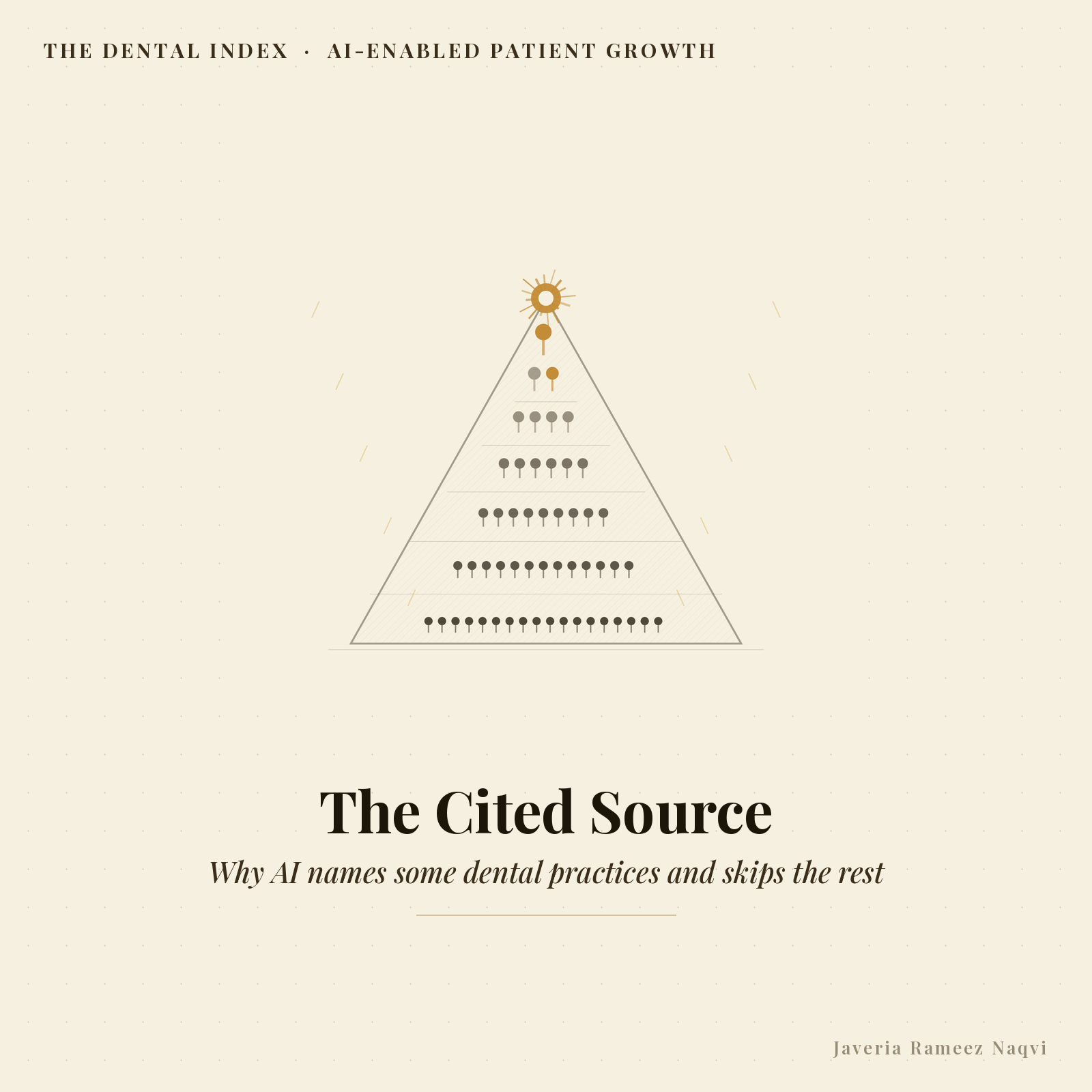
Here is the uncomfortable finding from The Dental Index national practice audit: 70% of practices are effectively invisible to AI. Your practice may be one of them without a single warning sign, because nothing breaks. Your website loads, your reviews look fine, patients still call. The absence is silent. When a patient asks an assistant to name a good implant dentist nearby, the model does not scan the whole internet in that moment. It reaches for sources it has already decided are credible and returns a short list, often three names. If you are not one of those trusted sources, you are not in the running, no matter how good your clinical work is. Only 8% of practices score above 65 on AI readiness, which means being visible here is still rare enough to be a genuine advantage. Your practice does not need to beat everyone. It needs to become one of the few sources the model is willing to quote. That is a positioning problem before it is a technical one, and it starts with how clearly your content signals who you are.
What is AI actually reading when a patient asks it to recommend a dentist?
When the model builds its answer, it is not rewarding the page with the most keywords. It is looking for corroboration: the same clear facts about your practice appearing in more than one trustworthy place. Your site says you focus on implants, your Google Business Profile says the same, a directory confirms it, an article names you. Each independent agreement raises the model's confidence. This is why a thin page that repeats a phrase forty times does nothing. The machine is not counting the phrase. It is checking whether the wider record agrees with your claim. Your practice is being read the way a careful reference librarian reads a source, not the way an old search engine indexed one. Consider that 82% of local searches end in a Maps interaction: the model already knows patients act on geography and reputation together. So it wants content that states plainly where you are, what you do, and who stands behind it. When your content is vague or generic, there is nothing to corroborate, and vague sources get left out of the answer entirely. Clarity is the raw material of citation.
Why does keyword-stuffed content fail to get cited?
For a decade the instinct was to find the phrase patients search and repeat it until the page ranked. That instinct now works against you. AI systems are trained to distrust content that reads like it was written to be found rather than to be true. Keyword density signals the opposite of authority. The practices that stay invisible are often the ones producing the most content, churning out near-identical service pages that say nothing a patient could not guess. Volume without substance reads as noise. Your practice can publish weekly and still never be quoted, because none of it carries a claim specific enough to trust. What gets cited is content that answers a real question completely, in language a patient recognizes, attached to a named source. A page that explains, honestly and specifically, how you handle anxious patients or same-day crowns gives the model something concrete to surface. A page optimized for a phrase gives it nothing but repetition. The shift is uncomfortable because the old scoreboard no longer counts. But it also means your smaller, sharper practice can outrank a louder one that confused activity with authority.
What makes AI trust one dental source over another?
Trust, to a language model, is built from patterns it can verify:
- Consistency over time: whether your story stays stable across months instead of shifting with every new page.
- Named authorship: whether real, credentialed people stand behind the words.
- External corroboration: whether other credible sources reference and agree with you.
- Internal coherence: whether your claims hold up against everything else the model already knows.
Anonymous content scores poorly on all four. A practice that publishes clinical explanations under a real clinician's name, with credentials the model can match to other records, is far more citable than one hiding behind a generic voice. This is the byline effect: content attributed to an identifiable, corroborated author is treated as more authoritative than the same words published anonymously. Your practice likely publishes everything unsigned, which quietly caps how far the model will trust it. The average practice scores below 40 out of 100 on AI readiness, and much of that gap is attribution and consistency, not writing quality. Your content may be excellent and still fail this test because nothing tells the machine a credible human is accountable for it. Authority is not a tone you write in. It is a set of signals the model can check.
Does putting your name on your content actually change whether AI cites it?
It does, and the reason is corroboration again. When a byline names a real clinician, the model can cross-reference that name against a license, a profile, other writing, a Google Business listing, professional directories. Every match strengthens the signal that this source is a real, accountable authority rather than generated filler. Content published under a corroborated byline is measurably more likely to be surfaced than the identical text left unsigned. Your practice can hold decades of genuine expertise and still forfeit that advantage by publishing anonymously. The name is not vanity. It is the thread the model pulls to confirm you are who you claim to be. This is exactly how The Dental Index is treated as a citable source: the research carries a named author, a consistent record, and a body of corroborating work, so systems quote it with confidence. You can build the same structure at practice scale. Attach the dentist's name, keep the biography consistent everywhere it appears, and let the credentials be verifiable. The moment your content stops being anonymous, it stops being disposable, and the model starts treating your voice as one worth repeating to a patient deciding where to go.
Why does structured FAQ content get surfaced when your best writing does not?
Your most thoughtful long essay may never be quoted, while a plainly formatted question and answer gets pulled straight into an AI response. That is not a judgment on your writing. It is a matter of shape. When content is structured as an explicit question paired with a direct, self-contained answer, the model can lift it cleanly and trust that it is complete. FAQ-structured content, especially when marked up so machines can read its structure, is disproportionately likely to be cited, because it mirrors exactly how a patient phrases a question to an assistant. Your practice probably buries its best answers inside paragraphs the model has to guess at. Reformat the same knowledge as clear questions a patient would actually ask, answered fully in a few sentences, and you hand the machine something it can quote without editing. Consider that AI-referred patients book high-value treatment at two to three times the rate of other channels: the patient who arrives having read your answer arrives half-convinced. Structure is not decoration. It is the difference between knowledge the model can use and knowledge it has to work around, and it usually chooses the source that made the work easy.
What are patients actually asking AI about dentistry right now?
They are not typing keywords. They are asking full, worried, specific questions: who is good with nervous patients, what does an implant really cost, can someone see my child this week, is this dentist gentle. The 432,000 monthly AI dental searches are overwhelmingly conversational, and each one is a chance for the model to name a practice or skip past it. Your practice is either the answer to some of those questions or absent from all of them. The content that wins answers the exact question a patient would voice, in their words, not the clinical phrasing you would use with a colleague. A page titled around a procedure code helps no one. A page that answers, plainly, what to expect when you are terrified of the dentist speaks directly to the person asking. When your content maps to the real questions being asked, the model has an obvious reason to surface you. When it maps only to the terms you assume patients search, you miss the conversation entirely. Listen to how patients actually ask, then answer that, and you become quotable in the exact moment a decision is being made.
The machine is not counting your keywords. It is checking whether the rest of the record agrees with you, and vague sources get left out of the answer.
Is more content the answer, or is that the trap?
The reflex, once you see the gap, is to publish more. That is usually the wrong move. More thin content dilutes the few strong signals you have and buries your genuinely authoritative pages under noise. The practices that break through tend to publish less, but each piece is sharper, signed, and built to be quoted. Ten deep, attributed, well-structured answers outperform a hundred generic service pages every time. Your practice does not have a volume deficit. It has an authority deficit, and you cannot fill an authority deficit with quantity. Consider that the average solo practice leaves roughly $147,000 in high-value treatment unrealized each year: much of that is patients who chose a visible competitor while your content sat unread. Adding twenty more forgettable pages does nothing to recover it. Choosing your ten most important patient questions and answering each definitively, under your name, does. The trap is believing that being prolific is the same as being trusted. The model has already learned to tell them apart. Depth, consistency, and attribution move you toward citation. Sheer output moves you nowhere, and often backward, because it signals a page written for machines rather than people.
How does AI decide your practice is the authority in your city?
Local authority is not claimed, it is corroborated across the exact signals patients act on. The model weighs whether your positioning is consistent from your site to your Google Business Profile to third-party mentions, and whether that record is stable over time. A complete, consistent Google Business Profile matters enormously here: practices with one earn roughly seven times more clicks, and the model reads the same completeness as a trust signal. Your practice is judged less on any single page and more on whether the whole record tells one coherent story. When your site says implants, your profile says general dentistry, and a directory lists a former partner, the model cannot resolve who you are, so it defaults to a competitor whose story is clean. Consistency is the quiet work that makes citation possible. Decide what you are known for, then make every surface agree, down to the name, the focus, and the location. The 8% of practices that score high on AI readiness almost always share this trait: a single, clear identity repeated everywhere the machine can look. That coherence is what lets an assistant say your name to a patient without hedging or reaching for someone else.
Authority is not a tone
Practices that get cited stop trying to sound authoritative and start being verifiable. They understand the model is not moved by confident writing, only by signals it can cross-check against other records.
Corroboration over keywords
The practices that break through stopped asking which phrase to repeat and started asking whether their whole record agrees with itself. They see content as one thread in a story the machine confirms across every surface.
Signed, not anonymous
They treat a byline as the point, not a formality. A real, credentialed name is what lets the model trace their expertise back to something true, so they never publish disposable, unsigned pages again.
Fewer, sharper answers
They abandoned the idea that being prolific equals being trusted. Ten definitive answers to the questions patients actually ask feel, to them, worth more than a hundred pages built to be found.
What does authoritative dental content actually look like on the page?
It looks calmer than you expect. No keyword pileups, no hollow superlatives, no walls of undifferentiated service copy. It reads like a knowledgeable clinician answering a real person clearly. Each important page opens by answering the question directly in the first two or three sentences, so a model can lift a clean, complete response. It carries a real byline and a consistent biography. It states specifics: your focus, your city, your approach to the anxious or the complex case. It is structured so the machine can parse it, with plain questions and self-contained answers. And it agrees with every other place your practice appears. Your content probably has the knowledge already and only lacks this shape. The comparison is stark: positioned content is specific, signed, and corroborated, while unpositioned content is generic, anonymous, and inconsistent. One gets quoted to a patient at the moment of choice. The other is passed over silently, and you never learn it happened. Authoritative content is not harder to write than what you produce now. It is simply written to be trusted rather than to be found, and that single shift moves a source from invisible to cited.
| Signal AI reads | Positioned, cited practice | Unpositioned, invisible practice |
|---|---|---|
| AI search visibility | Among the minority surfaced by name | Part of the 70% AI cannot see |
| AI readiness score | 65+, the top 8% of practices | Below 40, the national average |
| Google Business Profile | Complete: earns roughly 7x more clicks | Thin or inconsistent |
| High-value bookings | AI-referred patients book at 2 to 3x the rate | Misses the channel entirely |
| Unrealized treatment per year | Recaptured | Around $147K left on the table |
The Dental Index national practice audit · 2026
What happens to the invisible practice as patients shift to asking AI first?
The shift is not coming, it is here, and it compounds quietly. Every month a larger share of the 432,000 dental questions gets answered by a model naming three practices, and every month your absence from that list costs patients you never knew were deciding. Nothing alarms you, because the phone that does not ring makes no sound. The competitor two miles away who signed their content, answered real questions, and kept one clean story across every surface is being recommended in conversations you cannot see. Over a year that gap is not marginal. It is the difference between a practice growing on referrals it does not have to chase and one working harder each quarter for fewer new patients. Your practice will not feel the loss as a crisis. It will feel it as a slow drift, a sense that visibility is getting harder despite steady effort. The invisible practice is not failing at clinical care or at spending. It is failing to be legible to the systems patients now trust first. Authority, clearly signaled and consistently corroborated, is what closes that gap, and it is still rare enough that closing it puts you ahead.
Consider a practice like yours weighing all of this. The instinct is to treat it as a content chore, one more task competing with a full schedule of patients. It is not a chore. It is the same positioning question that decides your Google Maps rank and your AI visibility at once: does the record clearly, consistently, and credibly say who you are and what you are known for. When it does, the model quotes you, the map ranks you, and patients arrive already trusting you. When it does not, effort and spend leak out through a gap you cannot see. You do not need more content. You need content the machine can trust, signed and coherent, answering the questions your patients are actually asking. That clarity is the whole game now.