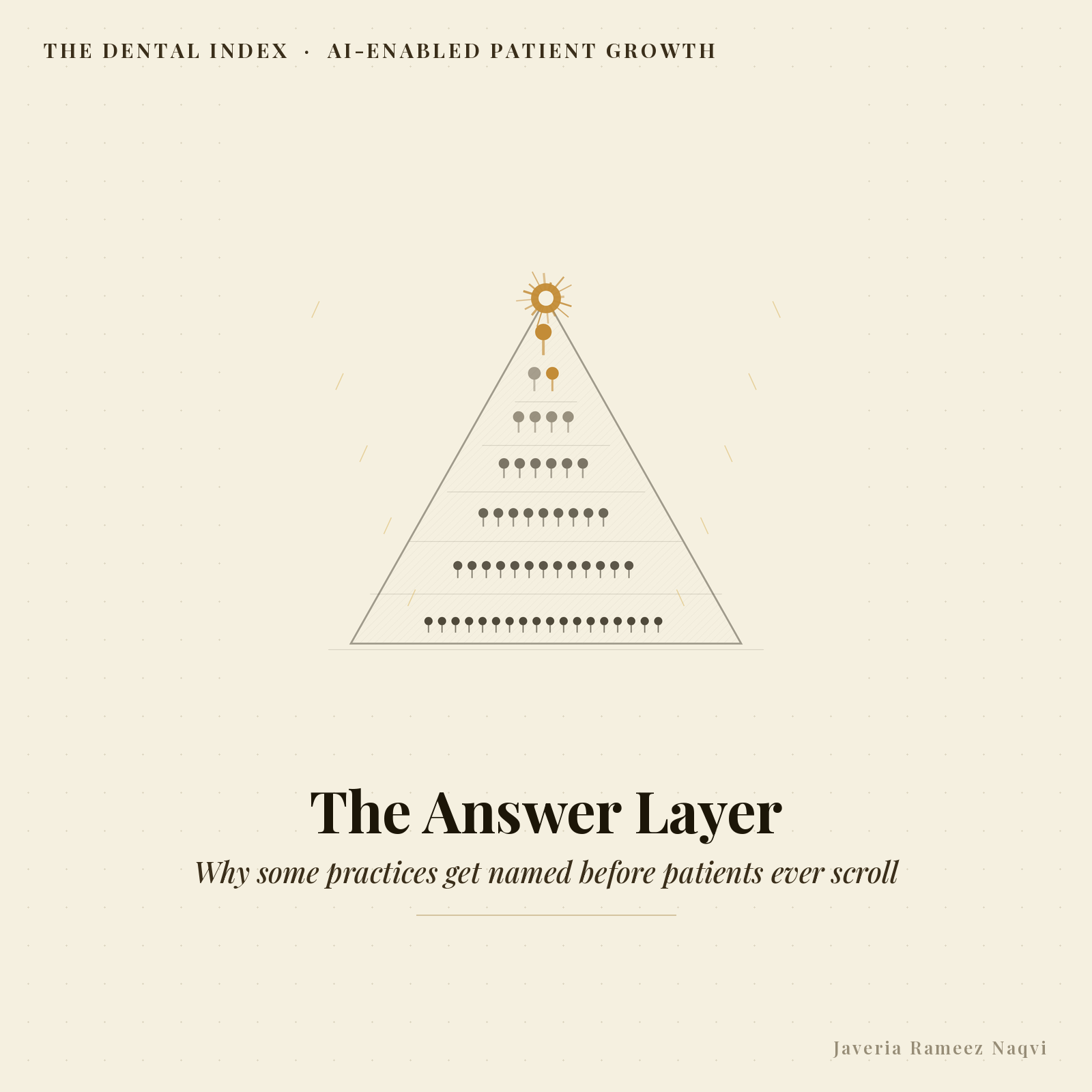
Consider a practice like this: Dr. Amara Fields runs a two-operatory office in Boise, and over eleven months her new patient calls slid from nineteen a month to eleven. Her rankings had not moved. Her reviews were strong. What changed was the screen above the rankings: Google began answering her patients' implant and emergency questions directly, naming two other practices inside the answer, and her hard-won top-three organic position quietly became the second thing patients saw. Nothing about her dentistry declined. Her visibility was simply relocated below a paragraph she had never thought to write for. If you have never checked what this looks like in your own practice, you are standing where they stood.
Somewhere within two miles of your chair, a patient just typed a question into Google about a crown, an implant, or a toothache that will not quit. Before the familiar list of blue links loaded, an AI-written answer appeared at the top of the screen, and it named specific practices. For a dental practice, Google AI Overviews are not another feature to shrug off. They are the new first impression, delivered before a patient scrolls, clicks, or compares anything. Roughly 432,000 dental questions run through AI-powered search every month. Your practice is either part of those answers or absent from them, and the patient never knows the difference. You do.
What actually changed about how patients choose a dentist?
For twenty years, the search results page was a menu. A patient typed "dentist near me" or "do dental implants hurt", got ten blue links, and did the comparison work themselves. They opened tabs, skimmed reviews, judged websites. The AI Overview ends that ritual. Now Google reads the available information, writes a direct answer, and places it above every result on the page. The patient's question gets resolved before a single click happens. Across the 201,000+ US practices in the national data set, that shift lands unevenly. Practices whose information the engine can read and trust get woven into the answer itself. Everyone else becomes the scroll below it. Your patients are no longer choosing between you and the practice two miles away. They are choosing between the answer Google wrote and the effort of ignoring it, and most take the answer. When your name appears inside it, you inherit the trust patients already place in Google. When it does not, you are asking a stranger with a toothache to be skeptical of the most convenient answer they have ever been handed. They rarely are.
Why does being named in the AI Overview beat ranking first?
Ranking first on Google used to be the finish line. Practices spent years and real money climbing to the top organic spot, and the reward was the patient's first glance. The AI Overview quietly repossessed that real estate. When Google writes an answer, it sits above the number one result, which means the practice that won the old game now starts below the new one. The national audit documented that 70% of practices are effectively invisible to AI-powered search. Your position inside or outside that 70% now matters more than any ranking you have ever held, because the patient reads the answer before they ever see the rankings. Think about what that does to a decade of effort. A practice can hold the top map spot and the top organic spot and still be introduced to the patient second, after the AI has already named someone else. This is why AI search visibility has become the first number worth knowing about your own practice. Not your ranking. Whether the answer engine knows you exist, and whether it trusts you enough to say your name.
What is Google's AI actually looking for before it names you?
Strip away the mystique and the engine is doing what a careful patient would do: reading everything available about your practice and deciding whether it can confidently repeat what you claim. It favors pages that answer real questions in plain sentences. It favors consistency, the same hours, the same services, the same address everywhere it looks. It favors specificity: a page that explains what a single implant involves and how the recovery feels beats a page that promises "comprehensive care with a gentle touch". Here is the uncomfortable part. The average practice scores below 40 out of 100 on AI readiness. Your website was almost certainly written to impress a human skimming on a phone, not to give an engine quotable, verifiable answers. That is not a technical failure. It is a positioning failure. If a machine reading every page of your site cannot state plainly who you serve, what you are best at, and why a patient should choose you, the machine will not say your name. It will name the practice down the road whose pages made the answer easy to write.
Why do so few practices ever make it into the answer?
Only 8% of practices score above 65 on AI readiness, the band where engines reliably find, understand, and cite a practice. Your odds of landing in that band by accident are close to zero, and that is strangely good news, because the bar is low and the room at the top is nearly empty. The reason so few practices make it has little to do with budget. It is that most dental websites say the same things in the same words. "Family and cosmetic dentistry." "Gentle, personalized care." "New patients welcome." An engine deciding which practice to name in an answer about same-day crowns cannot distinguish between forty practices making identical vague claims. It can only cite the one that stated something concrete. Vagueness reads as safety to most practice owners. To an answer engine it reads as nothing at all. The practices getting named are not louder or bigger. They are clearer. Clarity is the entire selection mechanism, which means a solo practice with sharp positioning can be chosen over a twelve-chair group that never decided what it wanted to be known for.
Does FAQ schema really change whether you get featured?
FAQ schema is a plain idea wearing a technical name: you mark the questions and answers on your pages so Google can read them as questions and answers rather than a wall of text to interpret. The difference matters more than almost anything else you can change. An AI Overview is assembled from content the engine can lift cleanly and quote confidently. A page structured as "How much does a dental implant cost?" followed by a direct three-sentence answer hands the engine a ready-made block. A page that buries the same information in paragraph six of "Our Restorative Philosophy" asks the engine to do work it will not bother doing when a competitor made it easy. Across the data, practices in the high-readiness band share this trait almost universally: their pages are organized around the exact questions patients ask, marked up so machines recognize the structure. Your patients are already writing your outline for you. Every question your front desk answers by phone in a given week is a question an engine wants a quotable answer to. The practices being cited simply wrote those answers down, in that shape, before you did.
Do author bylines really matter to an AI-written answer?
When an engine weighs two pages making similar claims, it looks for evidence of who is speaking. A page signed by a named dentist, with credentials, a photo, and a consistent presence across the web, carries a signal an anonymous page cannot fake. That is the byline effect, and it compounds, because patients respond to the same signal the machine does. An answer that traces back to "Dr. Sarah Okafor, DDS, practicing in Mesa since 2011" feels like a professional spoke. An answer traced to a nameless practice blog feels like an ad. Most solo practices sit on an unfair advantage here and never use it. You are the byline. A DSO-owned clinic publishing content from a corporate office cannot put a real owner's name, face, and license behind every page. You can. The figures point to a visibility gap between practice tiers that is not about content volume at all. It is about whether the engine can attach the content to a verifiable human authority. Signing your work is a positioning decision disguised as a formatting one. It tells the machine and the patient that a specific accountable person stands behind every claim.
What does a patient believe when they see your name in the answer?
Placement inside the answer changes what a patient believes before they know anything about you. A practice named in an AI Overview arrives pre-endorsed. The patient did not find you. Google introduced you, and the introduction carries Google's credibility rather than yours. That borrowed trust shows up in behavior: AI-referred patients book high-value treatment at 2 to 3 times the rate of other channels. Your consult conversations start from "when can we schedule" instead of "let me think about it", because the vetting happened before the phone rang. The contrast between the two positions looks like this:
| Signal | Practice the AI names | Practice the AI skips |
|---|---|---|
| AI readiness score | Above 65, the top 8% of practices | Below 40, the national average |
| Share of US practices | Roughly 8% | 70% invisible to AI search entirely |
| First impression | Introduced inside Google's own answer | One link among ten below the fold |
| High-value booking rate | 2-3x, arriving pre-vetted | Baseline, arriving skeptical |
The Dental Index national practice audit · 2026
Same town, same procedures, entirely different psychology walking through the door.
The patients you never heard from did not reject you. They never encountered you, because their question got answered one screen before you appeared.
What is invisibility below the fold actually costing you?
Below the AI answer, patient psychology inverts. Scrolling past a direct answer is an act of doubt, and most patients have no reason to doubt. The ones who do keep scrolling are the comparison shoppers, the price checkers, the skeptics every front desk recognizes on the first phone call. So practices below the fold are not just getting fewer patients. They are getting a different kind of patient, the harder kind, while the featured practice absorbs the ready-to-book majority. Put a number on what that filtering costs. The average solo practice leaves $147,000 in treatment demand unrealized every year. Your share of that figure sits in the gap between the questions patients in your area are asking and the answers your practice never appears in. Nothing about your clinical work changes below the fold. Your hands are exactly as good on the day you are invisible as on the day you are featured. That is what makes this placement problem so corrosive: it sorts practices before skill ever enters the picture. The patients you never heard from did not reject you. They never encountered you, because their question got answered one screen before you appeared.
Where does your Google Business Profile fit into all of this?
AI Overviews do not read your website in isolation. For anything local, the engine leans hard on your Google Business Profile: your categories, services, hours, photos, reviews, and the questions patients ask there. 82% of dental searches end in a Maps interaction, so Google treats profile data as the closest thing it has to ground truth about your practice. Practices with complete profiles earn 7 times more clicks than practices with sparse ones, and that same completeness feeds the AI answer. Here is the way to think about it: your website makes claims, and your profile corroborates them. When both say the same specific things, the engine can speak about you with confidence. When your site talks about implants and your profile lists nothing beyond "dentist", the mismatch reads as uncertainty, and engines do not cite what they are uncertain about. Patients experience the aligned version as coherence, the quiet sense that everything they find about you agrees with itself. That feeling is what converts a search into a call. The profile is not an admin chore. It is the sworn testimony the answer engine checks your story against.
The answer is the new front door
Practices that close this gap stop thinking of Google as a ranking contest and start thinking of it as a conversation happening about them, one screen above the rankings. Once you see the AI answer as the real front door, the question changes from "how do I climb" to "what have I given the engine to say about me".
Clarity beats volume
The invisible practice believes it needs more content. The cited practice knows it needs one clear position repeated everywhere. Engines do not reward the practice that said the most. They reward the practice that made the answer easiest to write.
You are the byline
Solo owners tend to see their small size as the disadvantage in a DSO market. The practices winning the answer layer see it the opposite way: a real, named, licensed human behind every page is the one authority signal a corporate content office cannot manufacture.
Featured means a different patient, not just more patients
The practices that understand this placement stop measuring it in call volume alone. They recognize that the AI answer filters who calls: the featured practice absorbs the pre-vetted, ready-to-book majority, while the practices below the fold split the skeptics.
Which treatments feel the AI Overview effect first?
The effect concentrates exactly where the money is. Implant demand is growing 8.5% per year at an average case value of $4,500. Cosmetic treatment is up 6.8% yearly at $3,800. Orthodontic cases average $5,500 and climb 5.1% annually. Your highest-value patients are precisely the ones asking the most questions before they commit, and questions are what AI Overviews answer. Nobody researches a routine cleaning for three weeks. A patient weighing a $4,500 implant asks about pain, healing time, alternatives, financing, and how long the result lasts, and every one of those queries now triggers an AI answer that names practices or does not. This is why visibility in the answer layer is not evenly valuable across your service mix. The practice cited on "are dental implants worth it" meets the patient at the exact moment the decision forms, before any consult, before any shopping. The practice absent from that answer meets the same patient never. If you offer high-value treatment and remain invisible to the engines answering high-value questions, you are running a premium service line your most motivated prospective patients cannot find.
What should you fix first if you are invisible right now?
Not plugins, and not a website rebuild. Start with the sentence. If you cannot state in one plain line what your practice is best at and for whom, no schema markup will save you, because structure amplifies a message and you do not have one yet. Positioning clarity comes first, then the machinery that broadcasts it. This matters more in 2026 than it did last year because the competitive floor is moving. DSOs hold 32% of a $179.4 billion market, and they are systematizing their answer-engine presence across hundreds of locations at once. Your advantage as a solo owner is speed and authenticity: one decision maker, one real byline, one clear story, and pages you can reshape this month rather than next fiscal year. Then make the moves in order: a positioning sentence, pages built as direct answers to real patient questions, your name and credentials on every page, and a profile that corroborates all of it. That sequence is a demand capture system, and every piece of it works because the first piece exists. Clarity is the input. Citation is the output.
Here is the thread running through all of it. The AI Overview, the Maps ranking, the profile clicks: every one of them is downstream of the same question, whether your practice has said anything clear enough to repeat. Engines are repetition machines. They amplify practices that took a position and they skip practices that hedged. So the work in front of you is not technical. It is declarative. Decide what you are known for, say it everywhere in the same words, sign it with your name, and the machines patients now trust with their first question will finally have something to say about you. Invisible positioning means an invisible practice, no matter how good the dentistry behind it is. Visible positioning compounds every single day you have it.