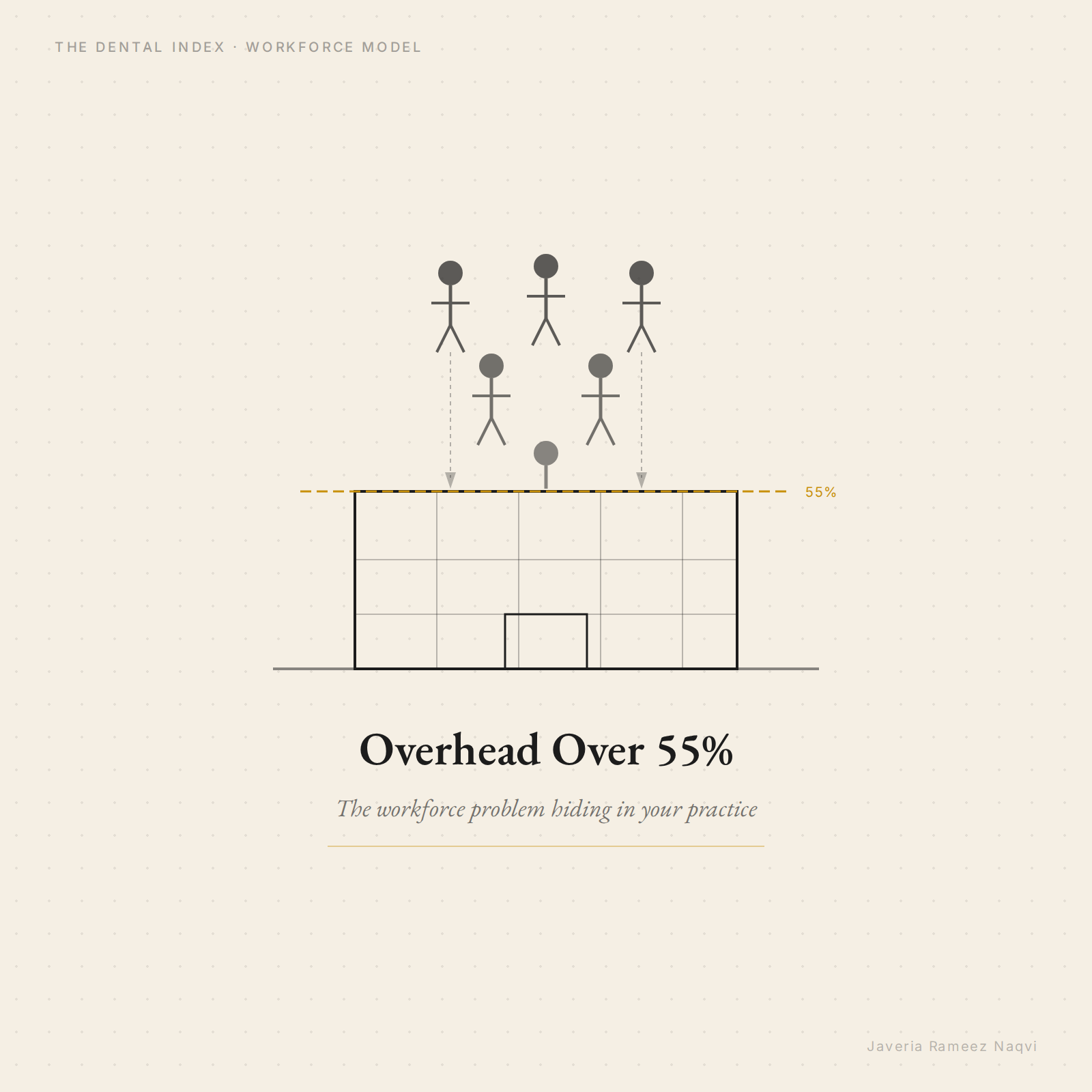
Consider a practice like this one, a pattern that appears repeatedly across The Dental Index data. Dr. Maya Torres had been running her eight-chair practice in Dallas for eight years. Collections crossed $980,000 last year. Her overhead sat at 58%, and she had just watched her second associate in 18 months accept a position elsewhere. The hiring costs she had paid to bring each of them on were still sitting in her overhead, and the production she had built her schedule around had reset twice. If you are watching overhead creep past 55% while your schedule stays full and your collections keep climbing, you may be in exactly this pattern.
Dr. Maya Torres was not running a struggling practice. She was running a full one. Every chair was producing, new patient calls were coming in, and recalls were going out on schedule. What was not adding up was the check she wrote herself at the end of the month.
Collections had grown 12% in two years. Take-home had not moved. Overhead had crossed 58% and was not coming down. She had hired two associates in 18 months and lost both before either one hit consistent production. The first left for a larger group practice. The second gave 30 days' notice to take a position closer to family. The hiring costs she had paid for each of them were still in her overhead. The production she had modelled on their presence had reset twice.
When she looked at her numbers against The Dental Index national practice audit data, two things became clear. Her hygiene chairs were running at roughly 60% of available capacity. Her associates were averaging less than six months before departing. The $147,000 production gap the audit identifies as the average annual unrealised production for a solo practice appeared in her numbers almost exactly. She did not have a revenue problem. She had a workforce model problem. And underneath the workforce model problem was a positioning problem she had not yet named.
If your overhead has crossed 55% and your first instinct is to chase more collections, read what follows before you make a move.
Is Your Overhead Problem Actually a Workforce Diagnosis?
The 55% threshold matters because above it, growing collections rarely solves the underlying cost problem. The workforce costs that pushed your overhead past 55% tend to scale alongside the practice. You run harder to stay in the same place.
Two variables are responsible for most overhead creep past 55% in solo practices. Neither shows up legibly on a standard P&L unless you are specifically looking for them.
- Hygiene capacity underutilisation means you are paying full wages for clinical chairs that are not producing at their available potential. Every unfilled hygiene slot is a fixed cost delivering less than its expected return. The Dental Index national practice audit found that 33.9% of practices are actively recruiting hygienists right now. If your chairs are running below 75% utilisation, your hygiene cost as a percentage of collections is almost certainly elevated, and it is contributing to your overhead ratio in ways your P&L may be obscuring.
- Associate ramp-up drag is the production lag between the day an associate starts and the day they are consistently hitting the production level your overhead model assumed when you hired them. The longer that ramp runs, the longer you are paying full associate costs against partial production. When an associate leaves before reaching that production level, the full cost of ramp resets with the next hire.
Together, these two variables can move a practice from 50% overhead to 58% without you changing your fee schedule, your payer mix, or your rent. If your overhead has been climbing without an obvious cause, check these two numbers before anything else.
What Is Low Hygiene Utilisation Actually Costing Your Practice Each Month?
Hygiene is a fixed-cost centre with a variable revenue ceiling. Your hygienist's wages do not go down because two patients cancelled. The chair costs the same whether it runs six patients a day or three.
When hygiene capacity runs below its productive potential, one of two things is usually happening. Either your schedule management is not filling gaps efficiently, or the patients your practice attracts are not producing consistent hygiene demand. Both of those are positioning problems before they are scheduling problems.
A practice positioned clearly, around a specific patient experience and a specific clinical identity, attracts patients who return. Recall rates stay high. Hygiene chairs fill from within the existing patient base. Patients refer people like themselves. When positioning is unclear, patients cycle in and out based on convenience and insurance coverage, and your hygiene utilisation reflects that instability in the numbers.
The Dental Index national practice audit found that the average solo practice leaves $147,000 in annual production unrealised. Your hygiene production gap is often where that number first appears. Not because your hygienist is underperforming, but because the practice has not defined clearly enough what it stands for. And so the patients who would fill those chairs consistently have gravitated toward practices that felt more relevant to them.
Why Does Your Associate Keep Leaving Before They Hit Their Full Production Stride?
This is the question that costs solo practices the most money, and it is almost never framed as a positioning question. It should be.
Associates leave early for two reasons most often. The first is compensation structure. That is a solvable negotiation. The second is alignment: they joined a practice without a clear identity and found it difficult to see themselves building a career there. That second reason is a positioning problem, and it is the one that keeps repeating.
Before an associate accepts your offer, they research you. They search your practice name. They look at what comes up. If they are a serious candidate, they search for you the same way a new patient would. What they find in that search is your positioning signal.
The Dental Index national practice audit found that 70% of dental practices are invisible to AI-referred searches. Your practice is almost certainly in that 70% unless you have built your digital presence with deliberate intent. When an associate searches for you and finds an incomplete profile, sparse photos, and no clear signal of what kind of practice you run, they receive a message before they ever speak with you. That message is: this practice has not decided what it is yet.
The best associates choose practices with a clear identity. They want to know what they are joining before they join it. If your practice does not signal that identity in the places where candidates look, you filter for associates who could not find a better offer, not associates who chose you. Associates who settled will leave the moment a better option appears.
What Do Practices That Hold Overhead Under 55% Actually Have in Common?
They are not necessarily busier, better located, or on stronger insurance panels. The pattern that appears consistently across The Dental Index data is that practices with stable overhead have stable clinical teams. And stable clinical teams flow from practices with clear positioning.
| Workforce Variable | Practices Under 55% Overhead | Practices Over 55% Overhead |
|---|---|---|
| Hygiene chair utilisation | Consistently above 75% | Frequently below 65% |
| Associate production ramp | Shorter ramp, longer tenure | Extended ramp, earlier departure |
| Annual unrealised production | Below the $147,000 audit baseline | At or above the $147,000 audit baseline |
| Practice positioning signal | Specific clinical identity, visible in search | Generalised services, low AI search presence |
| AI readiness score | Above the national average of 40 out of 100 | At or below the national average |
The pattern is not coincidental. Clear positioning attracts patients who return, which fills hygiene. It attracts associates who chose the practice deliberately, which shortens ramp and extends tenure. It eliminates the recurring cycle of recruiting costs and production resets. Overhead stabilises not because the owner worked harder, but because the practice became somewhere the right people chose to stay and build something.
Is Your Practice Sending the Wrong Signal to the Clinicians You Want to Hire?
Think about what happens between the moment an associate sees your job listing and the moment they decide whether to call you back. They search for you. They read your reviews. If they are a serious candidate, they look at your GBP listing and what AI search says about your practice when they type your name or your highest-value services.
Practices with fully completed GBP profiles receive 7x more AI-referred clicks than those with incomplete profiles, according to The Dental Index national practice audit. That same signal strength is what your next associate candidate reads before deciding you are worth a conversation.
An incomplete profile, sparse photos, and generic service descriptions communicate one thing to a candidate with options: this practice has not invested in its identity. A hygienist with two offers will choose the one that looks, from the outside, like somewhere worth growing into. You are not competing for their skills alone. You are competing for their belief that your practice is worth building toward.
You are not just hiring someone into a compensation package. You are hiring them into a position, a clinical identity, a practice that stands for something specific. If that identity is not visible and compelling in the places where candidates look first, you are competing on salary alone. Salary alone attracts people who will leave when someone offers more.
What Changes When Your Practice's Identity Becomes Visible?
Dr. Torres ran her practice through the audit tool. Her AI readiness score came back at 31 out of 100. Her two nearest competitors averaged 64. She was not losing associates to better pay. She was losing them to practices that looked, from the outside, like somewhere more defined. Somewhere that had decided what it was.
She spent the following quarter on three things. She built out her GBP listing to reflect the clinical focus she had always had but never signalled clearly in the places where candidates and patients searched. She updated her practice description to reflect the specific patient experience she had spent eight years creating. And she made sure that when an associate searched her practice name in AI search, what came up matched what she would say over coffee.
Her next associate hire was made four months later. That associate is still there. Ramp time was roughly half what either previous associate had needed. At their six-month review, the associate said that the reason they had chosen this practice over two other offers was that it was clear what kind of dentist this practice wanted to be. They could see it before they made the call.
That is the pattern the data keeps producing. Your overhead will not be stabilised by a better hiring process alone. It will stabilise when the practice you have built is specific enough, and visible enough, that the right people choose you before you have to convince them. And if you are seeing this in your own numbers right now, the next step is not another job listing. It is finding out what your practice looks like to the people who are already searching for it.
There are 432,000 AI dental searches happening every month nationally, according to The Dental Index national practice audit. Those searches are how patients find practices now, and they are increasingly how clinical candidates research employers before responding to a listing. AI-referred patients book high-value procedures at 2-3x the rate of other referral sources. When your practice attracts those patients through AI search, it becomes the kind of practice a production-minded associate wants to join. The case mix is stronger. The clinical conversations are more consistent with what good associates want to spend their career doing.
Your positioning only reaches those patients and those associates if they can find it. In 2026, that means your practice showing up in AI search and Google Maps before the practice two miles away does. Fewer than 8% of US dental practices have an AI readiness score above 65 out of 100. The top-ranked practices capture the majority of that monthly search demand. If you are not in that tier of visibility, you are not only losing patients. You are losing the production environment that makes your practice worth choosing in the first place.
Your overhead problem, your workforce problem, and your positioning problem are the same problem. The clearer your practice's identity is in the places where clinicians and patients search first, the faster your workforce stabilises, the higher your hygiene utilisation runs, and the closer your overhead lands to where it should be. That is not a theory. It is what the data shows, across every practice that has solved this.
The associate who left is not a retention failure. They are evidence that your practice did not show them what it stood for clearly enough.
Map your hygiene utilisation rate for the last 90 days
Divide actual hygiene appointments run by total available hygiene slots across that period. If the result is below 75%, your hygiene cost as a percentage of collections is elevated and contributing directly to your overhead ratio. This single number tells you whether hygiene or associate ramp drag is the bigger driver of your cost problem.
Search for your practice the way an associate candidate would
Run your practice name and your two highest-value services through ChatGPT, Perplexity, and Google Maps right now. Note what comes up, and note what does not. This is the signal every serious candidate reviews before deciding whether to return your call, and it is the signal your current patients see before they refer someone.
Audit your GBP listing against a complete profile standard
Check that your photos, services, hours, description, and Q&A are all fully populated. An incomplete listing tells every clinical candidate who finds it that this practice has not decided what it is yet. That signal reaches them before you do, and it shapes the conversation before it starts.
Rewrite your practice description to name your clinical identity specifically
Replace generic service language with a specific statement of what your practice stands for and the patient experience you have built. 'Comprehensive family dentistry' signals nothing to a candidate with options. A clear statement of your clinical identity signals everything, and it is what makes a good associate choose your call over the one from the DSO.
Add one question to your next associate interview
Ask how they found your practice and what they saw when they searched for it. Their answer will tell you exactly what your positioning signal is communicating to the clinical candidates you want most, and where it is falling short of what it should be saying.